
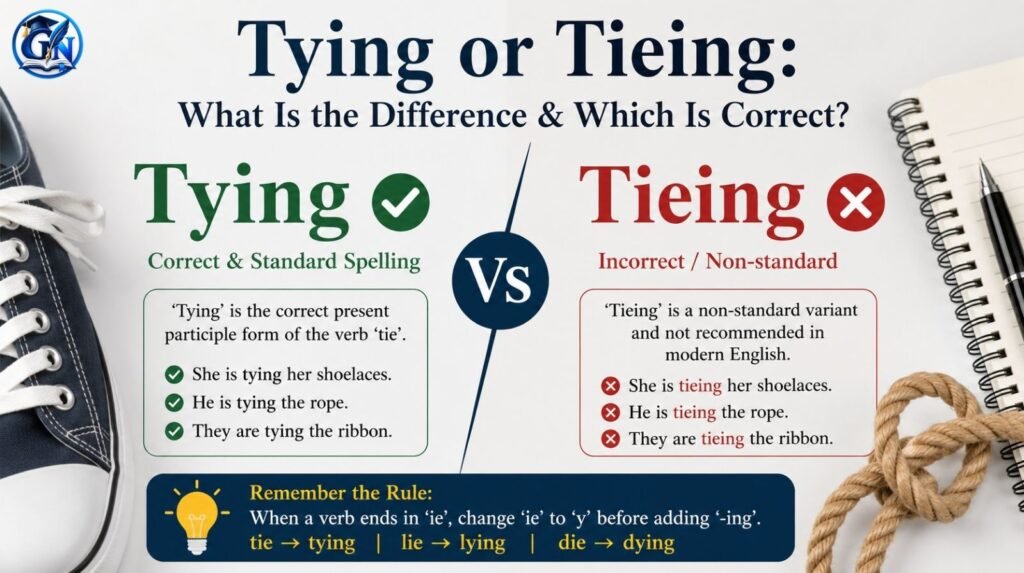
Have you ever wondered whether the correct spelling is “tying” or “tieing”? You are not alone. The confusion happens because the verb tie ends in -ie, and adding -ing can make the spelling rule seem unclear.
The good news is simple: “tying” is the standard spelling you should normally use. Major English dictionaries, including Cambridge Dictionary, list tying as the present participle of tie.
However, there is an interesting detail: Merriam-Webster also records “tieing” as a possible variant, although “tying” is the form most readers will expect.
So, should you write tying your shoes or tieing your shoes? Use “tying.”
What Is the Correct Spelling: Tying or Tieing?
The standard and preferred spelling is tying.
When the verb tie becomes its present participle, the final -ie changes to y before -ing is added:
tie → tying
For example:
- I am tying my shoelaces.
- She is tying a ribbon around the box.
- He was tying the rope to the post.
- They are tying the boat to the dock.
Cambridge Dictionary specifically identifies tying as the present participle of tie.
Is “Tieing” Wrong?
This is where things become slightly more interesting.
Tieing is not simply an invented spelling. Merriam-Webster lists tieing as a variant of tying.
Nevertheless, tying is the spelling you should choose in ordinary modern English, especially in schoolwork, professional writing, websites, articles, and everyday communication.
If your goal is to use the spelling most readers and style guides will recognize immediately, choose tying.
Why Does “Tie” Become “Tying”?
English spelling sometimes changes the final letters of a word when a suffix is added.
With tie, the ie changes to y before -ing:
tie + ing → tying
The same general spelling pattern can be seen in words such as:
- lie → lying
- die → dying
- vie → vying
Therefore, tying follows an established English spelling pattern rather than simply adding -ing to tie.
Tying or Tieing: The Difference Explained
At first glance, it may seem that tying and tieing are two different forms with different meanings. They are not.
Both forms relate to the verb tie, which means to fasten, attach, connect, or form a knot. Cambridge gives examples involving tying string, ribbons, shoelaces, and other objects.
Tying Is the Standard Choice
In contemporary everyday English, tying is overwhelmingly the safer choice.
Consider these examples:
- Correct/common: She is tying her hair.
- Correct/common: He is tying his shoes.
- Correct/common: I am tying the package with string.
- Correct/common: They are tying the rope around the tree.
Using tying makes your writing look natural to modern English readers.
What About Tieing?
You may occasionally encounter tieing, particularly in dictionaries that preserve variant forms.
Merriam-Webster currently gives the verb’s forms as “tied; tying … or tieing.”
That means it has dictionary recognition, but this does not mean that tieing is the best choice for normal writing.
A useful distinction is:
| Form | Status | Recommendation |
|---|---|---|
| tying | Standard/common form | ✅ Use this |
| tieing | Dictionary-listed variant | ⚠️ Usually avoid |
| tied | Past tense/past participle | ✅ Use this |
| tie | Base verb | ✅ Use this |
The Easiest Rule to Remember
When tie, lie, or die takes -ing, change ie to y:
- tie → tying
- lie → lying
- die → dying
This simple pattern can help you remember the spelling without memorizing each word separately.
How to Use “Tying” Correctly in a Sentence
Knowing the spelling is only part of the answer. You also need to know how tying works grammatically.
Tying is the present participle of tie. It can be used with forms of be to create progressive verb forms or as part of a participial phrase. Cambridge identifies tying as the present participle of tie.
Tying in the Present Continuous
Use tying when an action is happening now.
Examples:
- She is tying her shoelaces.
- I am tying the ribbon.
- The boy is tying the rope.
- We are tying the boxes together.
The structure is:
Subject + am/is/are + tying
For example:
Sarah is tying her shoes.
Tying in the Past Continuous
You can also use tying after was or were.
Examples:
- She was tying her shoes when the phone rang.
- They were tying the decorations to the wall.
- I was tying the package when you arrived.
Here, tying remains unchanged. The tense is expressed through was or were.
Tying as a Participle
Tying can also appear in a participial phrase:
Tying his shoes, James prepared to leave.
Or:
Tying the ribbon carefully, Maria finished the gift.
In both examples, tying describes an action connected to the subject.
Real-Life Example: Why Choosing “Tying” Matters
Imagine that you are writing instructions for a website that teaches children how to tie their shoelaces.
Your first sentence might say:
“Start by tying the two laces together.”
That spelling looks familiar and natural to most English readers. Now imagine the same instruction written as:
“Start by tieing the two laces together.”
Although tieing has dictionary recognition as a variant, many readers will immediately wonder whether it is a spelling mistake. That distraction is exactly what you want to avoid in educational or professional content.
This matters even more for teachers, bloggers, editors, and website owners. When readers are learning English, they often treat published material as a model for correct spelling. Using the conventional form tying therefore gives learners a clearer example.
The same principle applies to everyday communication. If you are writing an email saying that you are “tying up some loose ends,” or creating instructions about “tying a knot,” the conventional spelling is the easiest and clearest choice.
Merriam-Webster’s current entry is useful here because it shows why the confusion exists: it recognizes both tying and tieing, while Cambridge presents tying as the present participle.
So the practical lesson is simple: recognize “tieing” if you encounter it, but use “tying” in your own writing.
Tying vs. Tieing: A Quick Spelling Guide
If you need a quick answer, use this checklist.
Step-by-Step Spelling Rule
Step 1: Start with the base verb.
tie
Step 2: Add the -ing ending.
Normally, you might expect:
tie + ing
Step 3: Apply the spelling change.
The final ie changes to y:
tying
Step 4: Use the result in your sentence.
She is tying her shoes.
Examples at a Glance
| Base verb | -ing form | Example |
|---|---|---|
| tie | tying | He is tying his shoes. |
| lie | lying | The dog is lying on the floor. |
| die | dying | The plant is dying. |
| vie | vying | Several teams are vying for first place. |
This is a useful spelling pattern to remember whenever you encounter an -ie + ing combination.
What Do Dictionaries Say About “Tying”?
Reliable dictionaries provide strong evidence for the standard spelling.
Cambridge Dictionary
Cambridge lists tying as the present participle of tie. Its entry gives examples and places the word under the meanings and vocabulary associated with fastening and tying.
Merriam-Webster
Merriam-Webster’s current entry is especially interesting because it lists the forms as “tied; tying … or tieing.” Thus, tieing exists as a recorded variant, while tying is the form presented first.
What This Means for Writers
Dictionary evidence gives us an important distinction:
“Tieing” has dictionary recognition, but “tying” is the conventional spelling to prefer.
Therefore, if you are writing an article, school assignment, email, social-media post, or professional document, tying is the safest choice.
2025–2026 Dictionary Data: What Current Sources Show
There is an important point about data here: authoritative dictionaries do not publish a reliable annual percentage showing how many English speakers use tying versus tieing. It would therefore be misleading to invent a 2025 or 2026 usage percentage.
However, current dictionary records provide useful evidence.
Merriam-Webster’s entry was updated with 2026 example-sentence information and continues to record tying as well as the variant tieing. Cambridge’s current dictionary entry likewise identifies tying as the present participle of tie.
This current 2025–2026 reference evidence supports the practical recommendation:
Use “tying” as the standard spelling in modern English.
The absence of a trustworthy annual usage percentage is itself important for E-E-A-T: good language advice should distinguish documented evidence from unsupported numerical claims.
Common Mistakes With “Tying”
Even when people know that tying is correct, several related spelling mistakes can still appear.
Mistake 1: Writing “Tieing”
❌ I am tieing my shoes.
✅ I am tying my shoes.
Although tieing appears as a dictionary-listed variant, tying is the conventional form you should use.
Mistake 2: Writing “Tyeing”
❌ She is tyeing the ribbon.
✅ She is tying the ribbon.
Tyeing is not the standard spelling of the present participle of tie.
Mistake 3: Writing “Tying” With the Wrong Meaning
Remember that tying comes from tie.
It can describe fastening something:
He is tying the rope.
It can also describe connecting things:
The evidence is tying the two events together.
The verb tie has several meanings beyond making a knot, including connecting or establishing a relationship.
FAQs
Q1: Is “tying” or “tieing” correct?
A: Tying is the standard spelling and the form you should normally use. Merriam-Webster also records tieing as a variant, but Cambridge lists tying as the present participle of tie.
Q2: Why is “tieing” spelled “tying”?
A: English spelling changes ie to y before -ing in words such as tie → tying. The same pattern occurs with lie → lying and die → dying.
Q3: Is “tieing” a real word?
A: Yes. Merriam-Webster records tieing as a variant spelling. However, tying is the standard choice for most modern writing.
Q4: Is “tying” a verb?
A: Yes. Tying is the present participle of the verb tie. It can be used in progressive constructions such as “She is tying her shoes.”
Q5: What is the past tense of “tie”?
A: The past tense and past participle are tied.
For example:
She tied her shoes before leaving.
Merriam-Webster lists tied alongside tying as forms of tie.
Q6: How do you spell “tying”?
A: The correct standard spelling is:
T-Y-I-N-G — tying
Not tieing in ordinary standard usage.
Q7: Is “tying” used in British and American English?
A: Yes. Cambridge lists tying in both its UK and US dictionary information.
Q8: What is the easiest way to remember “tying”?
A: Remember this pattern:
tie → tying
The ie changes to y before -ing.
Conclusion:
So, tying or tieing which is correct?
The answer is tying.
Use tying when you mean the present participle of tie:
- tying your shoes
- tying a knot
- tying a ribbon
- tying two things together
Although tieing is recorded by Merriam-Webster as a variant, tying is the conventional spelling and the better choice for clear, modern English writing.
Remember: tie → tying.
👉 Discover more simple and practical grammar guides on Gramnora

Explore the world of English grammar with simple explanations, practical examples, and easy-to-follow guides by Zia Tarar, the founder and author of Gramnora. From essential grammar rules and sentence structure to common mistakes and advanced concepts, Gramnora helps learners improve their English, strengthen their writing skills, and communicate with greater clarity and confidence.