
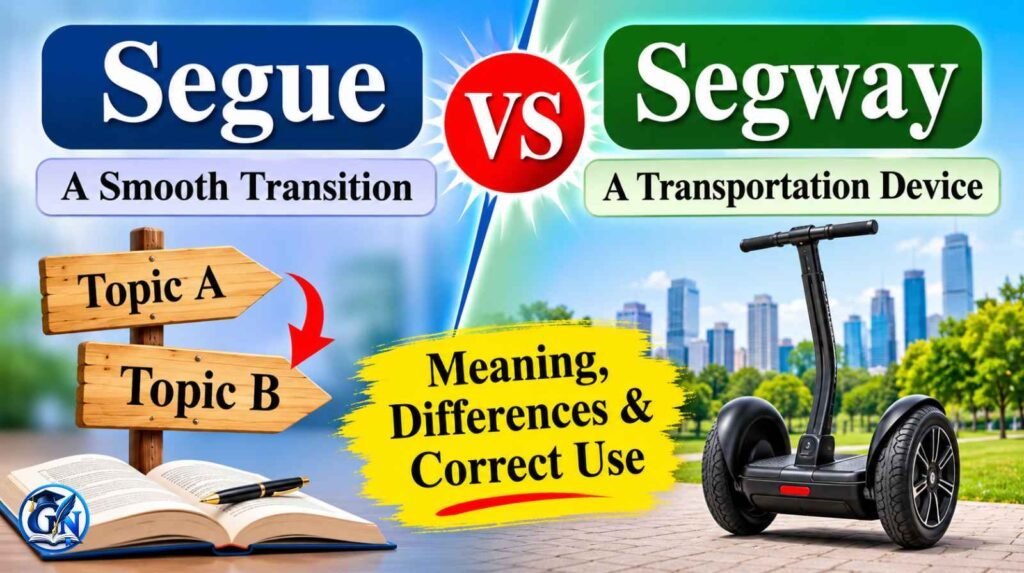
English contains many words that sound alike but have completely different meanings. Some of these words can easily confuse writers, students, and even experienced English speakers. Segue vs Segway is a good example because both words are pronounced almost identically, yet they refer to entirely different things.
The word segue describes a smooth transition from one topic, activity, scene, or idea to another. In contrast, Segway is a brand name associated with a self-balancing, two-wheeled personal transportation device. Although their pronunciations are nearly the same, their meanings, spellings, and uses are different.
For example, a presenter might use a segue to move smoothly from one subject to another during a presentation. Meanwhile, a tourist might ride a Segway while exploring a city.
Understanding the difference between these two words can help you avoid spelling mistakes and communicate more clearly. In this article, we’ll explore their definitions, examples, grammatical uses, and common mistakes so you can confidently use each word in the right situation.
What Does Segue Mean?
Segue is a noun and a verb that means to move smoothly from one subject, activity, scene, or situation to another. It is commonly used when discussing conversations, presentations, music, films, writing, and other situations involving transitions.
When someone uses a segue, they connect one idea to another without making the change feel sudden or awkward.
For example:
- The speaker used a funny story to segue into the next topic.
- The movie segues smoothly from the opening scene into the main storyline.
- Her question provided a natural segue into our discussion about education.
In everyday communication, a segue helps make conversations and presentations feel more organized and connected.
Segue as a Noun
As a noun, segue refers to a smooth transition between subjects, activities, or situations.
Here are some examples:
- That question was a perfect segue into our discussion about business.
- The presenter created an interesting segue between the two sections.
- The music provided a beautiful segue from the opening scene to the next.
- His personal experience became a natural segue into the topic of leadership.
Email example:
Imagine that you’re writing an email to a colleague about a completed project and want to introduce a new assignment.
Hi Daniel,
I wanted to let you know that we’ve successfully completed the first phase of the marketing project. As a segue into our next discussion, I’d also like to introduce the upcoming social media campaign and share a few ideas for its development. Please let me know when you’re available to discuss the details.
Best regards,
Michael
In this example, segue refers to the smooth transition from discussing the completed project to introducing a new campaign.
Segue as a Verb
As a verb, segue means to move smoothly from one subject, activity, or situation to another.
It can be used in different tenses:
- Present: segue
- Past: segued
- Present participle: segueing
Examples:
- Let’s segue into the next topic.
- The conversation segued from travel to business.
- The presenter is segueing into the final section of the speech.
- The film segues from comedy into drama.
Workplace example:
Imagine that Sarah is leading a team meeting. After discussing monthly sales, she wants to introduce the team’s upcoming marketing strategy.
She might say:
“Now that we’ve reviewed our sales performance, let’s segue into our marketing plans for next month.”
Here, Sarah uses segue as a verb because she is smoothly moving the discussion from one subject to another.
What Does Segway Mean?
Segway is a proper noun and a brand name associated with self-balancing personal transportation devices. These devices typically have two side-by-side wheels, a standing platform, handlebars, and an electric-powered balancing system.
A Segway allows a person to travel while standing upright. Riders control their movement by shifting their body weight and using the device’s controls.
Unlike segue, which describes a transition between ideas or activities, Segway refers to a physical transportation device.
Examples:
- We rented a Segway to explore the city.
- My brother bought a Segway for outdoor adventures.
- The tourists enjoyed riding their Segways around the park.
- She learned how to operate a Segway during her vacation.
Segway in Everyday Situations
The word Segway is generally used when discussing transportation, sightseeing, recreational activities, and personal mobility.
Travel example:
Imagine that Emma is visiting a popular tourist destination with her family. Instead of walking around the entire area, they decide to rent electric transportation devices.
She might say:
“We rented a Segway to explore the historical district. It was much more exciting than walking everywhere.”
In this situation, Segway is correct because Emma is talking about a transportation device rather than a transition between subjects.
Email example:
Hi Olivia,
I hope you’re having a great week! I wanted to share our plans for Saturday. We’re thinking about exploring the city center and visiting some popular attractions. I also found a place where we can rent a Segway, which could make our sightseeing trip even more enjoyable. Let me know if you’d like to join us!
Best,
Emily
Here, Segway refers to the electric transportation device that Emily and her friends plan to rent.

What Is the Main Difference Between Segue and Segway?
The main difference between segue and Segway is their meaning and purpose.
Segue describes a smooth transition from one topic, idea, activity, or situation to another. Segway, on the other hand, refers to a branded personal transportation device.
Although both words are pronounced similarly, they cannot be used interchangeably.
Consider these examples:
- Correct: The teacher used a question to segue into the next lesson.
- Incorrect: The teacher used a question to Segway into the next lesson.
- Correct: We rented a Segway for our sightseeing trip.
- Incorrect: We rented a segue for our sightseeing trip.
The first pair concerns a transition between subjects, while the second pair concerns transportation.
Here’s a quick comparison:
| Feature | Segue | Segway |
|---|---|---|
| Meaning | A smooth transition | A personal transportation device |
| Word type | Noun and verb | Proper noun |
| Pronunciation | /ˈseɡweɪ/ | /ˈseɡweɪ/ |
| Usage | Conversations, writing, music, presentations | Transportation and recreation |
| Example | Let’s segue into another topic. | I rented a Segway. |
Easy way to remember: If you’re talking about moving between ideas, use segue. If you’re talking about riding an electric transportation device, use Segway.
Why Are Segue and Segway Often Confused?

The main reason people confuse these words is their pronunciation. Both are pronounced approximately as “SEG-way,” making them homophones in common English usage.
However, their spellings and meanings are different.
There are several reasons this confusion happens:
Identical Pronunciation
Both words sound almost exactly alike when spoken. Someone hearing either word in a conversation may not immediately know which spelling is appropriate.
For example, consider these sentences:
- We need to segue into the next discussion.
- We need to rent a Segway for the tour.
When spoken aloud, the two highlighted words sound alike, but their meanings become clear from the context.
Different Origins
The word segue comes from Italian, where it means “follows” or “continues.” It entered English with the meaning of continuing smoothly from one thing to another.
Segway, meanwhile, is a brand name created for a personal transportation device. It became widely recognized through the development and popularity of self-balancing electric vehicles.
Autocorrect and Typing Mistakes
Because the words sound alike, people sometimes select the wrong spelling while typing. Autocorrect may not always identify the intended meaning, especially when both spellings are valid in different contexts.
For example, writing “Let’s Segway into the next topic” is incorrect because the intended word is segue.
When Should You Use Segue?
Use segue whenever you want to describe a smooth transition between topics, conversations, activities, scenes, or ideas.
It is particularly useful in professional writing, academic discussions, presentations, and everyday communication.
Here are some practical situations:
In Business Presentations
Presenters often use segue when moving from one section of a presentation to another.
Example:
“Now that we’ve discussed our current performance, I’ll segue into our goals for the next quarter.”
This sentence creates a natural connection between two related subjects.
In Academic Writing
Students and researchers can use segue to describe how one argument or idea connects to another.
Example:
“The author uses the final paragraph to segue into the discussion of environmental challenges.”
In Everyday Conversations
The word can also describe a natural change in casual discussions.
Example:
“Your comment about traveling is a great segue into our vacation plans.”
In Music and Entertainment
Musicians and filmmakers use the concept of a segue when moving smoothly between songs, scenes, or different sections of a performance.
Example:
“The DJ created a seamless segue between the two songs.”
When Should You Use Segway?
Use Segway when referring to the branded personal transportation device.
It is appropriate in situations involving sightseeing, tourism, recreation, and personal transportation.
Here are some examples:
During Sightseeing
Example:
“Our tour guide suggested renting a Segway to explore the historic streets.”
In Travel Discussions
Example:
“Have you ever ridden a Segway while visiting another country?”
In Product Discussions
Example:
“The company introduced a new Segway model with improved safety features.”
In Recreational Activities
Example:
“My friends and I enjoyed riding Segways during our weekend adventure.”
Remember that Segway is a brand name, so it should retain its capital S when referring to the brand.

Common Mistakes to Avoid When Using Segue and Segway
Even though the difference is straightforward, writers sometimes use these words incorrectly.
Understanding common mistakes can help you avoid confusion.
Mistake 1: Using Segway Instead of Segue
Incorrect: The manager used a joke to Segway into the serious discussion.
Correct: The manager used a joke to segue into the serious discussion.
Explanation: The manager is changing the subject smoothly, so segue is the correct word.
Mistake 2: Using Segue Instead of Segway
Incorrect: We rented a segue to explore the city.
Correct: We rented a Segway to explore the city.
Explanation: The sentence refers to a transportation device, so Segway is appropriate.
Mistake 3: Assuming Both Words Are Interchangeable
Incorrect: I bought a Segway to transition between different meeting rooms.
Correct: I bought a Segway to travel between different areas of the workplace.
Correct: I used a segue to transition from one meeting topic to another.
Explanation: Although both words sound alike, their meanings are completely different.
Mistake 4: Incorrect Capitalization
Incorrect: We rented a segway during our vacation.
Correct: We rented a Segway during our vacation.
Explanation: When referring to the branded device, use the proper noun Segway with a capital S.
Tips to Remember the Difference Between Segue and Segway

If you frequently confuse these words, a few simple memory tricks can make the distinction easier.
- Segue = Smooth transition: Think of moving smoothly from one subject to another.
- Segway = Transportation: Think of the electric two-wheeled device you can ride.
- Segue appears in writing and conversations: It connects thoughts, topics, and activities.
- Segway appears in travel and transportation: It refers to a physical device.
You can also remember these two example sentences:
- “Let’s segue into the next topic.”
- “Let’s ride a Segway around the city.”
Once you associate each word with its meaning, choosing the correct spelling becomes much easier.
Frequently Asked Questions
1. Is Segue or Segway Correct?
Both segue and Segway are correct English words, but they have different meanings. Segue refers to a smooth transition between topics, ideas, or activities, while Segway is a brand name associated with self-balancing personal transportation devices.
2. What Is the Main Difference Between Segue and Segway?
The main difference is their meaning. Segue describes a smooth transition from one subject or activity to another, whereas Segway refers to a two-wheeled personal transportation device.
3. Are Segue and Segway Pronounced the Same?
Yes, segue and Segway are pronounced almost identically, like “SEG-way.” However, they have different spellings, meanings, and grammatical uses.
4. Is Segue a Verb or a Noun?
Segue can function as both a noun and a verb. As a noun, it means a smooth transition between subjects or activities. As a verb, it means to move smoothly from one topic, idea, or situation to another.
5. What Is the Plural of Segway?
The plural of Segway is Segways. It refers to more than one Segway transportation device. For example: “The tourists rented three Segways for their city tour.”
6. Can Segue Be Used in Everyday Conversation?
Yes, segue can be used in everyday conversations, although it is somewhat more common in professional, academic, and creative contexts. For example: “That’s an interesting point, and it gives us a nice segue into our next discussion.”
7. Why Do People Confuse Segue and Segway?
People often confuse these words because they have almost identical pronunciations. However, their meanings are different: segue describes a transition, while Segway refers to a personal transportation device.
8. Is Segway a Generic Name for All Electric Scooters?
No. Segway is a brand name, not a universal term for all electric scooters or personal transportation devices. Although people sometimes use the name casually, it specifically identifies products associated with the Segway brand.
Conclusion
Understanding the difference between segue vs Segway is easier once you focus on their meanings rather than their pronunciation.
Segue is used when describing a smooth transition between topics, ideas, activities, or situations. It can function as both a noun and a verb and is commonly found in conversations, presentations, writing, and entertainment.
On the other hand, Segway is a brand name associated with self-balancing personal transportation devices. It is used when discussing riding, sightseeing, and personal mobility.
Although these words sound almost identical, they serve completely different purposes. Remembering that segue means transition and Segway means transportation device will help you use both words correctly in everyday conversations and professional writing.
👉 Explore more useful grammar tips and guides on Gramnora

Explore the world of English grammar with simple explanations, practical examples, and easy-to-follow guides by Zia Tarar, the founder and author of Gramnora. From essential grammar rules and sentence structure to common mistakes and advanced concepts, Gramnora helps learners improve their English, strengthen their writing skills, and communicate with greater clarity and confidence.