
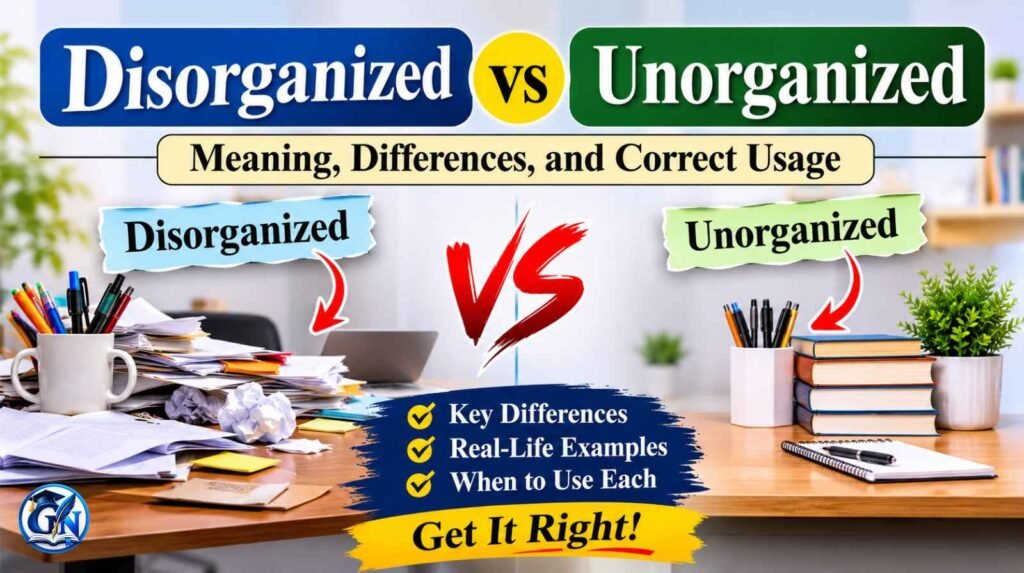
Have you ever wondered whether to use Disorganized vs Unorganized when describing a messy room, an untidy workspace, or a poorly planned event? These two words look similar and are sometimes used interchangeably, but they can communicate slightly different ideas depending on the context.
Both disorganized and unorganized are correct English words. They describe situations where things lack order, structure, or proper arrangement. However, disorganized generally suggests that something has lost its organization or is arranged poorly, while unorganized often describes something that has not been arranged, structured, or organized in the first place.
Understanding the difference between these words can help you choose the right expression in everyday conversations, professional emails, academic writing, and workplace communication.
In this article, we’ll explore the meanings of disorganized vs unorganized, explain when to use each word, and provide practical examples to help you understand their differences.
What Does Disorganized Mean?
Disorganized is an adjective that describes someone or something that lacks proper order, structure, or arrangement. It can also describe something that was previously organized but has become messy, confused, or poorly arranged.
The word is formed by adding the prefix dis- to organized. The prefix dis- often suggests the opposite of something or a reversal of a particular condition.
For example, if someone has a well-organized office but allows documents, stationery, and other items to pile up everywhere, their office may become disorganized.
Similarly, a person who regularly forgets appointments, loses important documents, or struggles to manage daily responsibilities may be described as disorganized.
Examples:
- My bedroom becomes disorganized whenever I have a busy week.
- Sarah is a little disorganized and often forgets where she puts her keys.
- The company’s records were so disorganized that employees struggled to find important information.
- Our manager noticed that the project had become disorganized after several team members changed their responsibilities.
- His disorganized schedule made it difficult to attend every meeting on time.
In these examples, disorganized describes people, places, or situations that lack proper order or structure.
What Does Unorganized Mean?
Unorganized is an adjective that describes something that has not been organized, arranged, or structured properly. It often refers to something that lacks a formal system, planned arrangement, or established structure.
The word is formed by adding the prefix un- to organized. The prefix un- commonly expresses the opposite of a particular condition.
For example, if a group of friends decides to meet without choosing a location, setting a time, or making any arrangements, their gathering may be described as unorganized.
Similarly, a collection of documents that has never been sorted into folders can be called unorganized.
Examples:
- The meeting was unorganized because nobody prepared an agenda.
- We joined an unorganized group of volunteers to clean the local park.
- The files remained unorganized because nobody had arranged them into separate folders.
- Their event was completely unorganized, with no clear schedule or assigned responsibilities.
- The students submitted their research notes in an unorganized format.
In these examples, unorganized emphasizes the absence of proper planning, arrangement, or structure.
Disorganized vs Unorganized: What Is the Main Difference?
The main difference between disorganized and unorganized is the way they describe a lack of order or structure.
Disorganized often suggests that something is poorly arranged, confused, or has lost its previous organization. In contrast, unorganized generally emphasizes that something has not been organized or arranged into a proper system.
However, their meanings overlap considerably, and both words can describe similar situations.
Consider these examples:
- Disorganized: The office became disorganized after several employees left important documents on their desks.
- Unorganized: The office was unorganized because nobody had established a proper filing system.
In the first sentence, the office’s existing arrangement has become messy. In the second, the office lacks an established organizational system.
Here’s a simple comparison:
| Disorganized | Unorganized |
|---|---|
| Lacks proper order or structure. | Has not been properly arranged or structured. |
| Can suggest disorder or confusion. | Often emphasizes the absence of organization. |
| Can describe something that has lost its organization. | Can describe something that was never organized. |
| Commonly describes people, places, schedules, and systems. | Commonly describes groups, activities, collections, and arrangements. |
Remember: This distinction is a useful general guideline, not an absolute grammatical rule. In many situations, both words are acceptable.
When to Use Disorganized
Use disorganized when you want to describe someone or something that is messy, confused, poorly arranged, or lacking an effective system.
It is especially appropriate when an existing arrangement has become difficult to manage.
Describing a Messy Room
Imagine that Emma usually keeps her bedroom clean and organized. However, after preparing for an important examination, she leaves books, clothes, and papers scattered around.
You could say:
“Emma’s bedroom has become disorganized because she has been too busy studying to clean it.”
Here, disorganized is appropriate because the room has lost its previous order.
Describing a Person
A person who frequently forgets appointments, misplaces belongings, or struggles to manage responsibilities can be described as disorganized.
Example:
“Michael is quite disorganized, so he often forgets important deadlines.”
The word describes Michael’s difficulty maintaining order in his daily activities.
Describing Workplace Management
Disorganization can also affect professional environments. When employees receive unclear instructions, important documents go missing, or responsibilities overlap, a workplace may become disorganized.
Example:
“The department became increasingly disorganized after the management team introduced several changes without proper communication.”
This sentence highlights confusion and a breakdown in the existing working structure.
Using Disorganized in a Professional Email
Imagine that you are writing to your colleague about a project that has become difficult to manage.
Subject: Concerns About Project Organization
Hi Daniel,
I wanted to discuss a few concerns regarding our current project. Some tasks have become disorganized, and several team members seem unsure about their responsibilities. I think we should review the project schedule, clarify everyone’s duties, and establish a better system for tracking progress. Please let me know when you’re available to discuss this.
Best regards,
Alex Morgan
Here, disorganized appropriately describes a project that has become confusing and difficult to manage.
When to Use Unorganized
Use unorganized when something has not been properly arranged, planned, or structured. It is particularly useful when emphasizing the absence of an established organizational system.
Describing an Unplanned Event
Imagine that a group of friends decides to organize a birthday celebration but makes no arrangements beforehand. Nobody chooses a venue, prepares decorations, or plans activities.
You could say:
“The birthday celebration was unorganized because nobody made any arrangements in advance.”
Here, unorganized emphasizes the lack of preparation.
Describing a Collection of Documents
Suppose a student saves research materials on a computer without creating folders or assigning meaningful file names.
Example:
“Jessica’s research documents were completely unorganized, making it difficult to locate specific information.”
The word works because the documents have not been arranged into a proper system.
Describing a Group Without Formal Structure
Sometimes, people work together without having official leadership, assigned responsibilities, or established rules.
Example:
“We started as an unorganized group of volunteers before establishing a formal community organization.”
In this situation, unorganized describes the group’s lack of formal structure.
Using Unorganized in a Professional Email
Imagine that you need to inform your manager that a collection of project materials has not been arranged properly.
Subject: Organizing Project Documents
Hi Olivia,
I noticed that the project documents are currently unorganized, and some important files are difficult to locate. Could we arrange them into separate folders based on project stages and document types? This would make it easier for everyone to access the information they need. Thank you for your help.
Best regards,
James Wilson
Here, unorganized describes documents that have not been arranged into a suitable filing system.
Disorganized vs Unorganized in Everyday Situations
Both words can appear in everyday conversations, but the context helps determine which one communicates your intended meaning more clearly.
Let’s look at some common situations.
At Home
- Disorganized: My kitchen becomes disorganized whenever I cook several meals at once.
- Unorganized: Our kitchen storage system is unorganized because we never assigned specific places for different items.
At School
- Disorganized: The teacher’s desk looked disorganized after collecting assignments from the entire class.
- Unorganized: The students submitted their notes in an unorganized manner without separating the different subjects.
At Work
- Disorganized: The team became disorganized after the project manager unexpectedly resigned.
- Unorganized: The company had an unorganized training process because it lacked a structured program.
During an Event
- Disorganized: The conference became disorganized when the speakers arrived late and the schedule changed.
- Unorganized: The conference was unorganized from the beginning because nobody prepared a schedule.
These examples show that both words can describe similar circumstances, but their emphasis can differ.
Are Disorganized and Unorganized Interchangeable?
Yes, disorganized and unorganized are interchangeable in many situations because both can describe a lack of order, arrangement, or structure.
However, they are not always equally natural or precise.
For example:
- “My desk is disorganized.”
- “My desk is unorganized.”
Both sentences are understandable and grammatically correct. However, disorganized is generally the more natural choice when describing a messy desk.
Now consider another example:
- “The event was disorganized.”
- “The event was unorganized.”
Both sentences are correct. The first can emphasize confusion and poor coordination, while the second can emphasize a lack of planning or preparation.
The best choice depends on what you want to communicate.
If you want to emphasize confusion, disorder, or a breakdown in an existing arrangement, disorganized is often more suitable.
If you want to emphasize the absence of planning, preparation, or an established system, unorganized may be more appropriate.
Common Mistakes to Avoid
Although both words are correct, English learners sometimes use them without considering their intended meanings.
Here are a few common mistakes worth avoiding.
Assuming Unorganized Is Incorrect
Some people mistakenly believe that unorganized is not a proper English word. This is incorrect.
Unorganized is a recognized English adjective and is appropriate in sentences such as:
“The files were unorganized because nobody had sorted them.”
Using Both Words Without Considering Context
Although these words overlap, choosing one based on context can make your writing more precise.
For example:
“The meeting became disorganized after the unexpected announcement.”
This sentence naturally emphasizes confusion that developed during the meeting.
Confusing Disorganized With Unprofessional
A disorganized person is not necessarily unprofessional, careless, or irresponsible.
Someone may be hardworking and knowledgeable but still struggle to manage schedules or maintain an organized workspace.
Similarly, an unorganized event does not automatically mean that its organizers lack experience. It may simply mean that the event was not properly planned.
Assuming the Prefixes Always Create Completely Different Meanings
The prefixes dis- and un- can express different ideas, but their meanings sometimes overlap.
Therefore, you should not assume that disorganized always means something was previously organized or that unorganized can only describe something that was never organized.
The surrounding sentence and intended meaning matter.
Disorganized vs Unorganized: Which Word Is More Common?
Both words are used in modern English, but disorganized is generally a more natural choice when describing messy people, rooms, schedules, and situations.
For example:
- She is disorganized.
- My office is disorganized.
- The entire process became disorganized.
On the other hand, unorganized is useful when describing something that lacks a formal arrangement or established structure.
For example:
- The documents are unorganized.
- It was an unorganized event.
- They formed an unorganized group.
This does not mean that one word is universally better than the other. Both are correct, and neither should automatically be avoided.
How to Remember the Difference Between Disorganized and Unorganized
A simple way to remember the difference is to focus on the ideas associated with their prefixes.
Disorganized = Disorder or confusion.
Think of something that is messy, poorly arranged, or no longer functioning in an organized way.
Unorganized = Not organized.
Think of something that lacks a proper arrangement, plan, or established system.
For example:
- A previously tidy bedroom that becomes messy is disorganized.
- A collection of papers that has never been sorted is unorganized.
This simple distinction can help you choose the more appropriate word when writing or speaking English.
Frequently Asked Questions
1. Is Disorganized or Unorganized Correct?
Both disorganized and unorganized are correct English words. Disorganized generally describes something messy, confused, or poorly arranged, while unorganized often describes something that lacks a proper structure, plan, or arrangement.
2. What Is the Main Difference Between Disorganized and Unorganized?
The main difference is their emphasis. Disorganized often suggests disorder, confusion, or a breakdown in an existing arrangement. Unorganized usually emphasizes the absence of proper organization or structure. However, their meanings overlap in many situations.
3. Is Unorganized a Real Word?
Yes, unorganized is a real and grammatically correct English word. It is commonly used to describe people, activities, documents, and groups that lack proper organization or structure.
4. Is Disorganized a Negative Word?
Yes, disorganized generally has a negative meaning because it suggests confusion, disorder, or poor arrangement. However, it is not necessarily an insult. It can simply describe a person’s habits, a messy room, or a poorly managed situation.
5. Can I Use Disorganized to Describe a Person?
Yes, you can use disorganized to describe someone who struggles to maintain order, manage responsibilities, or keep track of important things. For example, “David is disorganized because he frequently forgets his appointments.”
6. Can Unorganized Describe a Group of People?
Yes, unorganized can describe a group of people that lacks formal leadership, established rules, or assigned responsibilities. For example, “The volunteers initially worked as an unorganized group before creating a formal organization.”
7. Which Word Should I Use in Professional Writing?
Both words are acceptable in professional writing. Use disorganized when discussing confusion, disorder, or poor coordination. Use unorganized when referring to missing structures, arrangements, or planning systems. Choose the word that best communicates your intended meaning.
8. What Is the Opposite of Disorganized and Unorganized?
The most common opposite of both words is organized. Depending on the context, words such as orderly, structured, systematic, and well-arranged may also communicate the opposite meaning.
Conclusion
Understanding disorganized vs unorganized becomes easier when you consider what each word emphasizes. Both are correct English adjectives, and both describe situations where proper order or structure is missing.
However, disorganized is generally more suitable when describing confusion, disorder, or something that has become poorly arranged. In contrast, unorganized often emphasizes the absence of a proper plan, system, or arrangement.
For example, a bedroom that becomes messy after a busy week can be described as disorganized, while a collection of documents that has never been sorted can be described as unorganized.
Although their meanings sometimes overlap, understanding these subtle differences will help you communicate more clearly and confidently. The next time you are unsure which word to choose, consider the situation and select the one that expresses your intended meaning most naturally.
👉 Explore more useful grammar tips and guides on Gramnora

Explore the world of English grammar with simple explanations, practical examples, and easy-to-follow guides by Zia Tarar, the founder and author of Gramnora. From essential grammar rules and sentence structure to common mistakes and advanced concepts, Gramnora helps learners improve their English, strengthen their writing skills, and communicate with greater clarity and confidence.