
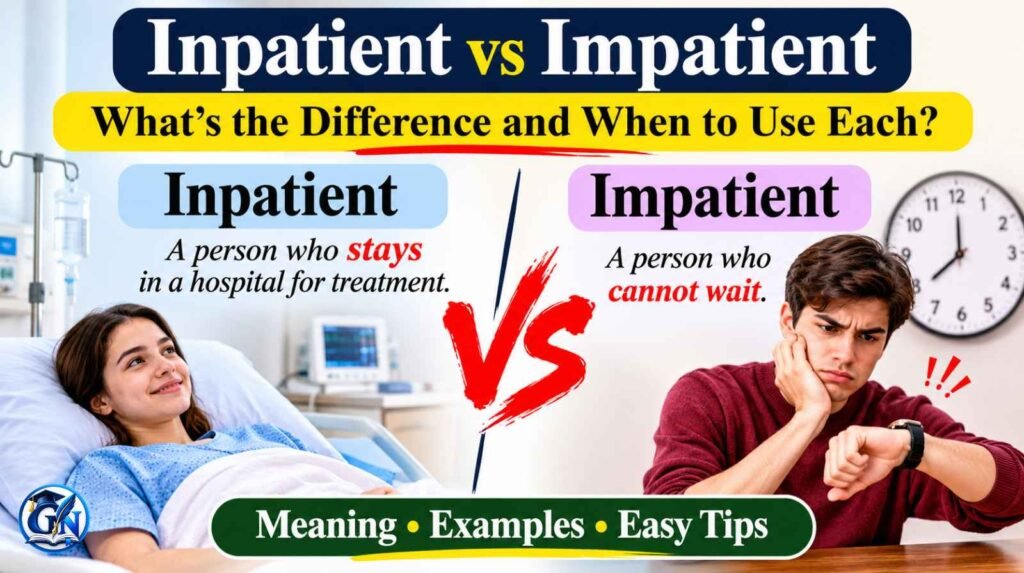
Have you ever confused Inpatient vs Impatient while writing an email, completing a document, or having a conversation? These two words look and sound somewhat similar, but they have completely different meanings. Using the wrong one can change the entire meaning of a sentence, especially when discussing healthcare or describing someone’s behavior.
The difference between inpatient vs impatient is easier to understand once you know what each word represents. Inpatient refers to someone who stays in a hospital or healthcare facility for medical treatment, while impatient describes someone who has difficulty waiting or becomes annoyed when something takes too long.
Although both words contain similar letters, they are not interchangeable. In this guide, you’ll learn their definitions, spelling differences, pronunciation, grammatical usage, and practical examples. We’ll also explore everyday situations and professional email examples to help you use each word correctly.
Inpatient vs Impatient: What Is the Difference?
The main difference between inpatient and impatient is their meaning and grammatical purpose.
Inpatient is a noun or adjective used in healthcare settings to describe someone admitted to a hospital or a medical facility for treatment that requires an overnight stay or an extended period of care.
Impatient is an adjective that describes someone who becomes frustrated, restless, or annoyed when they have to wait or when something does not happen quickly enough.
Here is a quick comparison:
| Word | Meaning | Part of Speech | Example |
|---|---|---|---|
| Inpatient | Someone admitted to a hospital | Noun | The inpatient needs medical attention. |
| Inpatient | Related to hospital care | Adjective | The hospital has an inpatient department. |
| Impatient | Unable or unwilling to wait calmly | Adjective | She became impatient while waiting. |
For example:
- Inpatient: Daniel was admitted as an inpatient after his surgery.
- Impatient: Daniel became impatient because his appointment was delayed.
Remember, inpatient is associated with medical treatment, whereas impatient is associated with someone’s attitude toward waiting.
What Does Inpatient Mean?
Inpatient refers to a person who has been formally admitted to a hospital or healthcare facility to receive medical treatment and care. In most cases, inpatient treatment involves staying at the facility overnight, although the exact admission arrangements depend on the healthcare system and type of treatment.
The word can also function as an adjective when describing hospital services, departments, facilities, or treatment provided to admitted patients.
For example:
- My grandfather is an inpatient at the city hospital.
- The doctor recommended inpatient treatment for the patient.
- The hospital recently expanded its inpatient services.
In these examples, the word relates specifically to medical care rather than someone’s personality or emotions.
When to Use Inpatient
Use inpatient when discussing hospital admissions, medical treatment, healthcare facilities, or patients who need to stay in a medical facility for care.
Here are some common situations:
Hospital Admission
When someone is officially admitted to a hospital for treatment, you can describe that person as an inpatient.
Example: Maria became an inpatient after doctors decided she needed further medical observation.
Medical Procedures
Some medical procedures require patients to remain in a hospital for recovery and monitoring.
Example: The surgeon recommended inpatient care following the complicated operation.
Healthcare Departments
Hospitals often have separate departments for inpatient and outpatient services.
Example: The hospital recently renovated its inpatient department to accommodate more patients.
Medical Records and Reports
Healthcare professionals frequently use the term in medical documents, admission reports, and patient records.
Example: The nurse updated the inpatient record before the patient’s scheduled examination.
Scenario Examples Using Inpatient
Let’s look at some realistic situations to understand how to use inpatient naturally.
Scenario 1: Talking About a Family Member
Suppose your friend asks why your father has not returned home after visiting the hospital.
You might say:
“My father was admitted as an inpatient because the doctors wanted to monitor his condition overnight.”
Here, inpatient correctly describes someone admitted to a hospital for continued medical care.
Scenario 2: Hospital Conversation
Imagine a hospital receptionist explaining the difference between two types of medical services.
Receptionist: “Our inpatient services are available for patients who need to stay in the hospital, while outpatient services are for people who receive treatment without being admitted.”
This example demonstrates how inpatient works as an adjective when describing healthcare services.
Scenario 3: Professional Email
Suppose you work in a healthcare organization and need to inform a colleague about a patient’s admission.
Subject: Patient Inpatient Admission Update
Dear Emily,
I wanted to inform you that Mr. Robert Wilson has been admitted as an inpatient for further medical evaluation. The healthcare team will continue monitoring his condition and provide the necessary treatment. Please update the relevant patient records accordingly.
Best regards,
James Miller
This email uses inpatient correctly because it refers to a patient who has been formally admitted to the healthcare facility.
What Does Impatient Mean?
Impatient is an adjective that describes someone who struggles to wait calmly or becomes frustrated when something takes longer than expected.
It can also describe a person’s desire for something to happen immediately or their lack of tolerance for delays.
Unlike inpatient, impatient has nothing to do with hospital admission. It is commonly used in everyday conversations, workplace communication, personal relationships, and professional writing.
For example:
- Sarah became impatient while waiting for her food.
- The manager was impatient to receive the final report.
- Don’t be impatient; good results take time.
In each sentence, impatient describes someone’s feelings, behavior, or attitude toward waiting.
When to Use Impatient
Use impatient when describing someone who is frustrated by delays, unwilling to wait, or eager for something to happen.
Here are some common situations:
Waiting for Something
When someone becomes annoyed because they have been waiting too long, impatient is the appropriate word.
Example: Ahmed became impatient after waiting nearly an hour for his appointment.
Workplace Situations
Employees and managers may become impatient when projects, decisions, or important tasks take longer than expected.
Example: The client grew impatient because the company had not delivered the requested documents.
Personal Relationships
You can use impatient when someone becomes frustrated while waiting for another person.
Example: Emma became impatient when her brother took too long to get ready.
Excitement and Eagerness
Impatient can also describe someone who is eager for something to happen, even when they are not necessarily angry.
Example: The children were impatient to open their birthday presents.
Scenario Examples Using Impatient
Here are some everyday situations that show how to use impatient correctly.
Scenario 1: Waiting at a Restaurant
Imagine you are having dinner with a friend, but the food is taking longer than expected.
You might say:
“I am getting impatient because we ordered our food almost forty minutes ago.”
Here, impatient describes your frustration with the delay.
Scenario 2: Workplace Conversation
Suppose your manager is waiting for an important project update.
Manager: “The client is becoming impatient because we haven’t provided the final report yet. Can you finish it today?”
This example shows how impatient can describe someone’s frustration with a delayed task.
Scenario 3: Professional Email
Imagine you need to remind a colleague that a client is waiting for an important response.
Subject: Follow-Up on Pending Client Request
Dear Michael,
I wanted to follow up on the pending client request. The client is becoming increasingly impatient because they have not received an update regarding the project. Could you please share the latest progress and let me know when we can provide a response? Thank you for your cooperation.
Best regards,
Sophia Anderson
In this email, impatient correctly describes the client’s frustration with the delay.
Inpatient vs Impatient: Key Spelling Differences
Although these words look similar, their spelling contains an important difference.
Inpatient begins with the prefix in-, followed by patient. It is associated with hospital admission and medical care.
Impatient begins with the prefix im-, followed by patient. It describes someone who lacks patience or has difficulty waiting.
The spelling difference is small, but the meanings are completely different.
Consider these examples:
- Inpatient: The hospital provides inpatient care for people who require continuous medical attention.
- Impatient: The customer became impatient after waiting for assistance.
A helpful way to remember the difference is to associate inpatient with a hospital patient and impatient with a lack of patience.
Common Mistakes to Avoid When Using Inpatient and Impatient

Many people confuse these words because they have similar spellings and pronunciation. However, using one instead of the other can create confusion.
Here are some common mistakes and their corrections.
Mistake 1: Using Inpatient to Describe Someone Who Cannot Wait
Incorrect: Sarah became inpatient because the meeting started late.
Correct: Sarah became impatient because the meeting started late.
Explanation: The sentence describes frustration caused by waiting, so impatient is the correct choice.
Mistake 2: Using Impatient to Describe a Hospital Patient
Incorrect: My uncle was admitted as an impatient after his surgery.
Correct: My uncle was admitted as an inpatient after his surgery.
Explanation: The sentence refers to someone admitted to a hospital, making inpatient the correct word.
Mistake 3: Confusing Inpatient and Outpatient
Incorrect: The doctor scheduled an inpatient appointment for a patient who would receive treatment and return home immediately.
Better: The doctor scheduled an outpatient appointment.
Explanation: Outpatient services generally involve treatment without formal hospital admission, while inpatient care involves admission to a healthcare facility.
Mistake 4: Using Impatient When Describing Medical Services
Incorrect: The hospital recently introduced new impatient services.
Correct: The hospital recently introduced new inpatient services.
Explanation: The sentence describes a type of hospital service, so inpatient is appropriate.
Easy Tricks to Remember Inpatient vs Impatient

If you frequently confuse these words, a few simple memory tricks can help you choose the correct spelling.
Associate Inpatient With a Hospital
Think of the word patient inside inpatient. An inpatient is someone admitted to a hospital for medical care.
Memory trick: Inpatient = In a hospital.
Associate Impatient With Patience
The word impatient describes someone who does not have enough patience to wait calmly.
Memory trick: Impatient = Not patient.
Look at the Meaning of Your Sentence
Before choosing either word, ask yourself what you are trying to describe.
- If you are discussing hospital admission or medical care, use inpatient.
- If you are describing frustration, restlessness, or eagerness while waiting, use impatient.
These simple tricks can help you avoid spelling mistakes in emails, assignments, conversations, and professional documents.
Inpatient vs Impatient: Example Sentences
The following examples will help you understand how both words work in different contexts.
Inpatient Example Sentences
- The hospital admitted several inpatients following the accident.
- My grandmother requires inpatient care after her operation.
- The doctor explained the hospital’s inpatient admission process.
- The inpatient department is located on the third floor.
- Daniel remained an inpatient for three days.
- The hospital recently improved its inpatient facilities.
- Nurses regularly monitor patients receiving inpatient treatment.
- The medical team prepared an inpatient recovery plan.
- My cousin was transferred to another hospital as an inpatient.
- The hospital offers specialized inpatient services for certain medical conditions.
Impatient Example Sentences
- The children became impatient while waiting for their parents.
- Jessica was impatient to hear the examination results.
- Please don’t become impatient; your turn will come soon.
- The customer grew impatient after receiving no response.
- My brother gets impatient when traffic becomes heavy.
- The manager was impatient to see the completed project.
- Everyone became impatient because the train was delayed.
- She sounded impatient during the telephone conversation.
- David was too impatient to wait for the announcement.
- The students became impatient when the teacher arrived late.
Frequently Asked Questions
1. Is Inpatient or Impatient Correct?
Both inpatient and impatient are correct English words, but they have different meanings. Inpatient refers to someone admitted to a hospital for medical care, while impatient describes someone who becomes frustrated or restless when waiting.
2. What Is the Main Difference Between Inpatient and Impatient?
The main difference is their meaning. Inpatient is related to hospital admission and medical treatment, whereas impatient describes a lack of patience or difficulty waiting calmly.
3. Is Inpatient One Word or Two?
Inpatient is written as one word. It is commonly used as a noun or adjective in healthcare settings. For example, “The hospital admitted the patient as an inpatient.”
4. Is Impatient a Positive or Negative Word?
Impatient is generally used with a negative meaning because it describes frustration or an inability to wait calmly. However, it can sometimes express excitement or eagerness, such as being impatient to start a vacation.
5. Can Inpatient and Impatient Be Used in the Same Sentence?
Yes. Both words can appear in the same sentence when discussing a hospitalized person’s feelings. Example: “The inpatient became impatient while waiting for the doctor to arrive.” Here, inpatient identifies the hospitalized person, while impatient describes that person’s frustration.
6. What Is the Opposite of Impatient?
The opposite of impatient is patient. A patient person can wait calmly without becoming frustrated or annoyed. Example: “Unlike his impatient brother, Daniel remained patient while waiting for the results.”
7. What Is the Difference Between Inpatient and Outpatient?
An inpatient is someone who is formally admitted to a hospital for medical treatment and care. An outpatient receives medical services without being admitted to the hospital. For example, someone staying overnight after surgery may be an inpatient, while someone visiting a clinic for a routine checkup is generally an outpatient.
8. How Can I Remember the Difference Between Inpatient and Impatient?
Remember that inpatient is connected to being in a hospital, while impatient is connected to having little patience. Associating each word with its meaning makes it easier to remember the correct spelling.
Conclusion
Understanding the difference between inpatient vs impatient is important for clear and accurate English communication. Although these words look similar, they serve completely different purposes.
Use inpatient when referring to someone admitted to a hospital or describing medical services provided to admitted patients. Use impatient when describing someone who becomes frustrated, restless, or eager while waiting.
For example, “The inpatient became impatient while waiting for the doctor” demonstrates how both words can be used correctly in the same sentence.
The easiest way to remember the distinction is that inpatient relates to hospital care, while impatient relates to a lack of patience. Once you understand this simple difference, choosing the correct word in everyday conversations, emails, and professional writing becomes much easier.
👉 Explore more useful grammar tips and guides on Gramnora

Explore the world of English grammar with simple explanations, practical examples, and easy-to-follow guides by Zia Tarar, the founder and author of Gramnora. From essential grammar rules and sentence structure to common mistakes and advanced concepts, Gramnora helps learners improve their English, strengthen their writing skills, and communicate with greater clarity and confidence.