
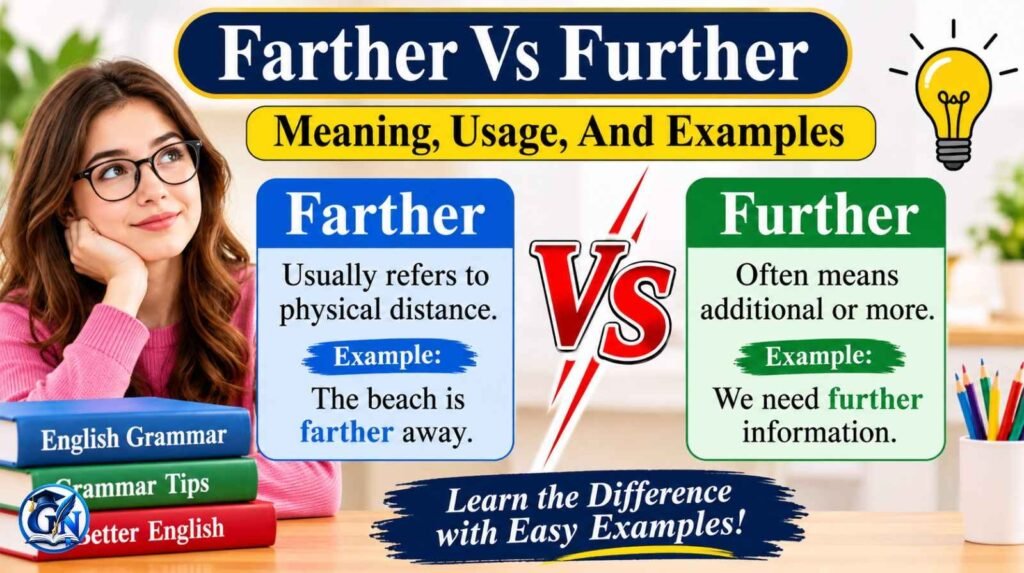
English contains many words that look and sound similar but have slightly different meanings. Farther Vs Further are two commonly confused words that often make writers unsure which one to use. Although both words can describe distance or something extending beyond a particular point, they are not always interchangeable.
The confusion usually happens because both words can refer to how far something goes, whether that means physical distance, additional information, or progress toward a goal. However, understanding their main differences makes it much easier to choose the correct word in everyday conversations, professional emails, academic writing, and other situations.
The simplest way to remember the distinction is that farther generally refers to measurable physical distance, while further usually refers to figurative distance, additional progress, or something extra.
For example:
- Farther: My house is farther from the station than yours.
- Further: We need further information before making a decision.
In this article, we will explore the meanings, differences, grammatical uses, and practical examples of farther and further so you can use both words confidently.
What Does Farther Mean?
Farther is an adverb or adjective used mainly to describe physical distance. It refers to how far away something is or how much additional physical distance someone or something travels.
It is commonly used when discussing locations, journeys, walking distances, driving distances, and other situations where distance can be measured.
For example:
- The supermarket is farther from my house than the shopping mall.
- Sarah ran farther than everyone else during the competition.
- We cannot walk any farther because the road is blocked.
- Their new office is farther away from the city centre.
In each example, farther describes an actual physical distance between two places or points.
Examples of Farther in Everyday Situations
Here are some practical situations that show how to use farther correctly.
Talking About Travel Distance
Imagine that Daniel and his friend are planning a road trip. Daniel wants to visit a nearby beach, but his friend suggests another beach that is much farther away.
Example:
“Let’s visit the beach near the town. The other one is much farther, and we will spend too much time driving.”
Here, farther is correct because the speaker is comparing the physical distance between two beaches.
Talking About Walking Distance
Suppose Emily is walking through a park and becomes tired. Her friend asks whether she can continue walking.
Example:
Emily: “Can we walk any farther? My feet are starting to hurt.”
Friend: “There is a bench just a little farther down the path.”
In this conversation, farther describes the physical distance Emily must walk.
Talking About Geographical Locations
Imagine that a company is deciding where to open its next office. One location is close to the city centre, while another is outside the city.
Example:
“The new branch is farther from the city centre, but it offers more parking space for employees.”
The word farther is appropriate because the sentence describes the actual distance between two locations.
Farther as an Adjective
Although farther is commonly used as an adverb, it can also function as an adjective.
An adjective describes a noun, and farther can describe something located at a greater physical distance.
Examples:
- We decided to take the farther road because it was less crowded.
- The farther building belongs to the university.
- She chose the farther entrance to avoid the traffic.
In these sentences, farther describes the nouns road, building, and entrance.
What Does Further Mean?
Further is used to describe something additional, more advanced, or extending beyond an existing point. Unlike farther, it is not limited to physical distance.
It is commonly used when discussing information, education, discussions, research, progress, opportunities, and future developments.
For example:
- We need further information about the project.
- The manager requested further clarification.
- She wants to further her education.
- We will discuss this matter further tomorrow.
In these examples, further does not describe a measurable physical distance. Instead, it refers to something additional or a continuation of an activity, process, or idea.
Examples of Further in Everyday Situations
Let’s look at some realistic situations where further is the appropriate choice.
Requesting Additional Information
Imagine that Olivia receives an email from her manager about a new assignment. However, some important details are missing, so she asks for additional information.
Example:
“Dear Mr. Wilson,
Thank you for sharing the project details. Could you please provide further information about the expected deadline and the responsibilities involved?
Best regards,
Olivia”
Here, further information means additional information that Olivia needs to understand the assignment.
Talking About Education
Suppose James has completed his bachelor’s degree and wants to continue studying for a master’s degree.
Example:
“After completing his bachelor’s degree, James decided to further his education by enrolling in a master’s programme.”
The word further is correct because it describes continuing or advancing education rather than travelling a physical distance.
Continuing a Discussion
Imagine that two colleagues are discussing a business proposal. They agree to continue the conversation during their next meeting.
Example:
“We can discuss the proposal further during tomorrow’s meeting.”
Here, further means continuing the discussion in greater detail.
Requesting Additional Clarification
Suppose a customer receives an unclear explanation from a customer service representative and wants more details.
Example:
“Dear Customer Support Team,
Thank you for your response. I would appreciate further clarification regarding the additional charges on my account.
Kind regards,
Michael”
In this situation, further clarification means more explanation.
Farther Vs Further: What Is the Main Difference?
The main difference between farther and further is the type of distance or continuation they describe.
Farther generally refers to physical distance that can be measured or estimated. Further usually refers to additional information, greater development, progress, or figurative distance.
Consider these examples:
| Farther | Further |
|---|---|
| We walked farther than expected. | We need further information. |
| The airport is farther away. | Let’s discuss this further. |
| She ran farther than her brother. | He wants to further his career. |
| The farther house is mine. | Further research is necessary. |
A useful trick is to remember:
- Use farther when talking about physical distance.
- Use further when talking about additional things, progress, or development.
However, there is some overlap in modern English. Further can also describe physical distance, particularly in expressions such as “further down the road.”
When Should You Use Farther?
Use farther when you are comparing or describing actual physical distances.
Here are some common situations.
When Comparing Two Physical Distances
When one location is physically more distant than another, farther is generally the preferred choice.
Examples:
- My school is farther from home than my brother’s school.
- The railway station is farther away than the bus stop.
- Their house is farther from the beach.
When Describing Travel
Farther is appropriate when discussing how much distance someone travels.
Examples:
- We drove farther than we originally planned.
- The runners had to travel farther to reach the finish line.
- You will need to walk farther to find the nearest pharmacy.
When Describing Physical Movement
When someone or something moves beyond a particular physical point, farther is often appropriate.
Examples:
- Move the chair farther away from the window.
- The dog ran farther into the garden.
- The ball rolled farther than anyone expected.
When Should You Use Further?
Use further when referring to additional information, development, progress, or continuation.
When Requesting More Information
Further is commonly used in professional and academic communication.
Examples:
- Please contact me if you need further assistance.
- We require further details before approving the application.
- The teacher provided further instructions to the students.
When Discussing Education or Career Development
Further can describe advancing knowledge, skills, or professional opportunities.
Examples:
- She wants to further her career in marketing.
- He decided to further his studies abroad.
- The training programme will help employees further their professional development.
When Continuing a Conversation or Activity
Further is suitable when something continues or develops beyond its current stage.
Examples:
- We will explore this topic further next week.
- The committee needs to investigate the complaint further.
- Let’s discuss the matter further before reaching a conclusion.
When Talking About Additional Actions
Further is also used to describe extra steps or actions.
Examples:
- No further action is required.
- The company announced further changes to its policies.
- Please let us know if you have any further questions.
Can Farther and Further Be Used Interchangeably?
In some situations, farther and further can be used interchangeably, particularly when describing physical distance.
For example:
- We walked farther down the road.
- We walked further down the road.
Both sentences are acceptable. They describe someone continuing along a physical route.
However, when discussing additional information, development, or progress, further is generally the better choice.
For example:
- We need further details about the proposal. (Correct)
- We need farther details about the proposal. (Incorrect in standard usage)
Similarly:
- She wants to further her education. (Correct)
- She wants to farther her education. (Incorrect)
Therefore, although the two words overlap in certain contexts, they should not be treated as completely interchangeable.
Farther Vs Further in American and British English
Both farther and further are used in American and British English. Their basic meanings are generally the same in both varieties.
However, further is often preferred in British English when describing physical distance, while American English commonly makes a stronger distinction between physical distance and figurative meaning.
For example:
American English:
- The hotel is farther from the airport.
- We need further information.
British English:
- The hotel is further from the airport.
- We need further information.
Both varieties accept these constructions, although farther is also perfectly understandable and correct in British English.
Common Mistakes When Using Farther and Further
Even experienced English speakers sometimes confuse these words. Understanding common mistakes can help you avoid them in your writing.
Mistake 1: Using Farther for Additional Information
Incorrect: Please send me farther details about the meeting.
Correct: Please send me further details about the meeting.
Why? Further means additional in this context. Farther generally describes physical distance.
Mistake 2: Using Further When Comparing Physical Distances
Although further is also acceptable in many physical-distance contexts, farther is often the clearer choice when comparing measurable distances.
Example:
Less precise distinction: The second hotel is further from the airport.
Clear alternative: The second hotel is farther from the airport.
Mistake 3: Confusing Further With Farther in Professional Emails
Incorrect: Please let me know if you need any farther assistance.
Correct: Please let me know if you need any further assistance.
Why? Further assistance means additional help, not help involving physical distance.
Mistake 4: Assuming Farther Is Always Correct for Distance
Further can also describe physical distance, especially when referring to an extension or continuation.
For example:
“Walk further down the hallway, and you will find the reception desk.”
This sentence is perfectly acceptable.
The important point is that farther is generally preferred for measurable physical distance, while further has a wider range of meanings.
Farther Vs Further: Examples in Sentences
Here are additional examples to help you understand how both words work in different contexts.
Farther Examples
- The library is farther from my office than I expected.
- We travelled farther than 200 miles during our holiday.
- Could you move your car farther away from the entrance?
- The children ran farther into the field.
- Her new apartment is farther from the university.
- The mountain looks much farther away than it really is.
- I cannot walk any farther because I am exhausted.
- Their village is farther north than ours.
Further Examples
- We need further information before making a final decision.
- Please contact the office for further assistance.
- The company plans to introduce further improvements.
- She wants to further her knowledge of English grammar.
- The teacher explained the topic further.
- No further discussion is necessary at this stage.
- The investigation requires further attention.
- Let me know if you have any further questions.
Frequently Asked Questions
1. Is Farther or Further Correct?
Both farther and further are correct English words, but they are used in different contexts. Farther generally refers to physical distance, while further usually means additional, more, or continued development.
2. What Is the Difference Between Farther and Further?
Farther generally describes measurable physical distance, such as the distance between two locations. Further refers to additional information, progress, development, or figurative distance. However, further can also describe physical distance in certain situations.
3. Is Further a Real Word?
Yes, further is a standard English word. It can function as an adverb, adjective, and verb. It is commonly used to describe additional information, continued progress, or something extending beyond an existing point.
4. Is Farther Only Used for Physical Distance?
Farther is primarily used for physical distance, especially when comparing measurable distances between locations or describing physical movement. Further is generally preferred for figurative distance and additional information.
5. Is It Farther Away or Further Away?
Both expressions are grammatically correct. Farther away is often preferred when describing measurable physical distance, while further away is also widely used, particularly in British English.
6. Should I Say Further Information or Farther Information?
The correct expression is further information because further means additional or more. Farther information is incorrect in standard English when referring to additional details.
7. Is It Further Assistance or Farther Assistance?
The correct expression is further assistance. It refers to additional help or support that someone may need. Farther assistance is not appropriate because the expression does not describe physical distance.
8. Can Further Be Used for Physical Distance?
Yes. Further can describe physical distance, particularly when referring to movement or continuation along a route. For example, “Walk further down the street to find the restaurant.” Both farther and further can be correct in this context.
9. Is Farther More Common in American English?
Farther is commonly used in American English when describing physical distance. However, further is also widely used by American speakers, particularly when discussing additional information, progress, and development.
10. How Can I Remember the Difference Between Farther and Further?
An easy way to remember the difference is to associate farther with physical distance and further with additional information or progress. For example, you travel farther to reach a destination, but you request further information to understand something better.
Conclusion
Understanding the difference between farther vs further becomes much easier when you remember their primary uses. Farther generally describes physical distance, such as travelling, walking, or comparing the locations of two places. Further usually refers to additional information, progress, development, or continuing an activity.
Although both words can sometimes describe physical distance, further has a broader range of meanings and is commonly used in professional, academic, and everyday communication.
The easiest rule to remember is: use farther for physical distance and further for additional information or progress. By following this simple distinction and practising the examples in this article, you can use both words more confidently and avoid common English grammar mistakes.
👉 Explore more useful grammar tips and guides on Gramnora

Explore the world of English grammar with simple explanations, practical examples, and easy-to-follow guides by Zia Tarar, the founder and author of Gramnora. From essential grammar rules and sentence structure to common mistakes and advanced concepts, Gramnora helps learners improve their English, strengthen their writing skills, and communicate with greater clarity and confidence.