
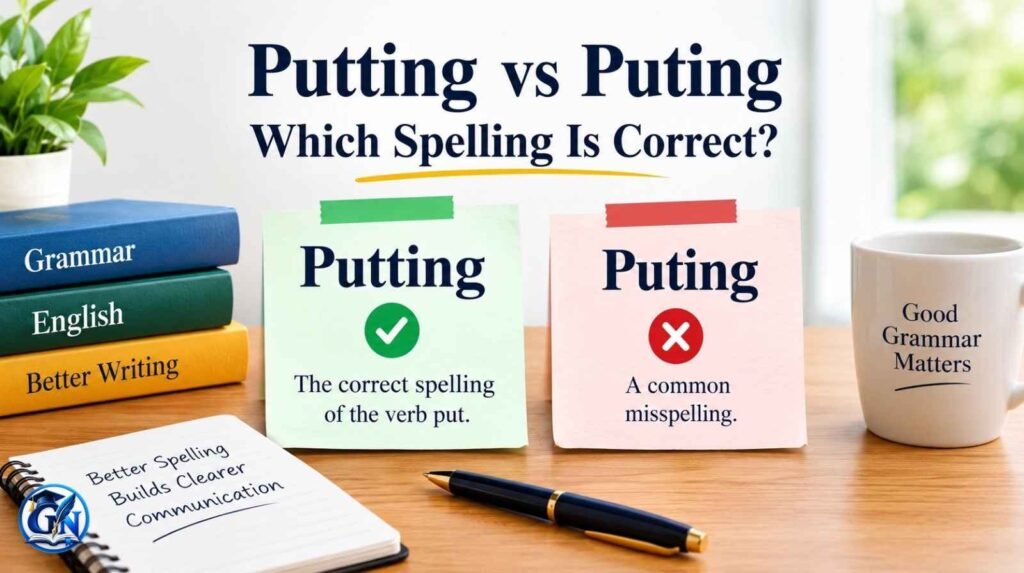
Have you ever wondered whether the correct spelling is Putting vs Puting? These two words look almost identical, so it is easy to miss the difference when writing quickly. However, only one is the standard spelling in English.
Putting is the correct spelling, while puting is a misspelling. The word putting is the present participle and gerund form of the verb put. It can describe placing something somewhere, taking an action, or participating in activities such as golf.
In this guide, you will learn why putting is correct, how to remember its spelling, how to use it in sentences, and which grammar rules explain the extra t.
What Is the Difference Between Putting and Puting?
The main difference between putting and puting is spelling. Putting is the correct English word, and puting is an incorrect spelling when you intend to use the verb put.
Although puting may look reasonable to some writers, it does not follow the standard spelling of this verb’s -ing form.
Putting: The Correct Spelling
Putting is formed by adding -ing to the verb put. Because put ends in a consonant-vowel-consonant pattern, the final consonant is doubled before adding the suffix.
Examples:
- She is putting her books on the shelf.
- I am putting my phone away.
- They are putting a lot of effort into the project.
- He enjoys putting in golf.
In each example, putting is spelled with two t’s.
Puting: The Incorrect Spelling
Puting is a common spelling mistake caused by forgetting to double the final consonant in put.
Incorrect: She is puting the dishes in the cupboard.
Correct: She is putting the dishes in the cupboard.
Incorrect: We are puting our plans into action.
Correct: We are putting our plans into action.
Remember that the standard spelling is always putting, with two t’s.
Why Is Putting Spelled With Two T’s?
The spelling of putting follows an important English spelling rule. When a short, one-syllable verb ends in a consonant-vowel-consonant pattern, the final consonant is generally doubled before adding a suffix that begins with a vowel, such as -ing.
The Consonant-Vowel-Consonant Rule
The verb put contains three letters:
- P: Consonant
- U: Vowel
- T: Consonant
This creates the consonant-vowel-consonant pattern. Therefore, when adding -ing, you double the final consonant.
The process is:
Put + ing = Putting
You do not simply write puting because the final t must be doubled under this spelling rule.
More Examples of the Same Rule
Here are other verbs that follow a similar pattern:
| Base verb | Correct -ing form | Incorrect spelling |
|---|---|---|
| Sit | Sitting | Siting (when meaning sitting) |
| Run | Running | Runing |
| Stop | Stopping | Stoping (when meaning stopping) |
| Get | Getting | Geting |
| Plan | Planning | Planing (when meaning planning) |
| Put | Putting | Puting |
Notice that some words, such as siting and planing, are real English words with different meanings. The issue is not that these letter combinations can never exist; it is that they are incorrect for the intended grammatical forms.
When Does This Rule Apply?
The consonant-doubling rule applies to many short verbs, but English spelling has exceptions and variations depending on stress, word endings, and regional conventions.
For example:
- Hop → Hopping
- Swim → Swimming
- Cut → Cutting
- Begin → Beginning
Understanding this rule helps you spell putting correctly and avoid similar mistakes in everyday writing.
How to Use Putting Correctly in Sentences
The word putting has several uses in English. It can describe physically placing something, making an effort, or performing a particular activity.
Putting Something Somewhere
This is one of the most common meanings of putting. It describes moving or placing an object in a particular location.
Examples:
- She is putting the groceries in the refrigerator.
- I am putting my shoes beside the door.
- He was putting the documents into a folder.
- They are putting the chairs around the table.
In these sentences, putting describes the action of placing something.
Putting in Effort or Taking Action
Putting can also appear in expressions that describe effort, resources, or action.
Examples:
- She is putting a lot of effort into learning English.
- The company is putting money into research.
- He is putting his experience to good use.
- We are putting the finishing touches on our presentation.
These expressions are common in professional communication, academic writing, and everyday conversation.
Putting in Sports and Other Activities
In golf, putting refers to hitting the ball with a putter, usually on the green, to move it toward the hole.
Examples:
- His putting has improved this season.
- She is practicing putting before the tournament.
- Good putting can make a significant difference in a golf game.
This is another reason the correct spelling matters: putting is used in several contexts, not only when placing objects.
Putting vs Puting: Comparison Table
Use this quick comparison to identify the correct spelling and understand how each form should be used.
| Feature | Putting | Puting |
|---|---|---|
| Spelling status | Correct | Incorrect for the intended verb form |
| Base verb | Put | Put |
| Formation | Put + ing, doubling the final t | Omits the required second t |
| Standard English usage | Yes | No, when intended to mean putting |
| Example | She is putting on her coat. | She is puting on her coat. |
| Suitable for formal writing | Yes | No |
Quick rule: Whenever you add -ing to the verb put, double the final t to form putting.
A Simple Way to Remember the Spelling
Think of the word as having three parts:
- Start with put.
- Double the final t.
- Add ing.
The result is putting.
A useful memory trick is to remember that put keeps its final consonant and doubles it before -ing. If you write puting, you have missed one t.
Common Mistakes to Avoid When Using Putting
Even experienced English learners sometimes make spelling errors when adding suffixes. Knowing the common mistakes can help you write with greater confidence.
Forgetting to Double the Final T
The most frequent mistake is writing puting instead of putting.
Incorrect: I am puting the files on your desk.
Correct: I am putting the files on your desk.
The solution is simple: remember the consonant-vowel-consonant spelling rule.
Confusing Putting With Other Word Forms
The word put can appear in different grammatical structures.
Examples:
- Present simple: I put my keys on the table every day.
- Present continuous: I am putting my keys on the table.
- Past simple: I put my keys on the table yesterday.
Notice that put has the same spelling in the present and past simple forms, but its -ing form becomes putting.
Relying Only on Spell-Check
Spell-checking tools can help identify mistakes, but you should also understand the rule behind the correction. Some errors may go unnoticed, particularly when a misspelling resembles a familiar word.
For more reliable writing, combine proofreading with a trusted dictionary and an understanding of English spelling patterns.
Real-Life Example: Correcting Putting in Everyday Writing
Imagine a student named Alex preparing an assignment about daily routines. Alex writes the following paragraph:
“Every morning, I am puting my books into my backpack. After breakfast, I am puting my lunch into a container and puting my water bottle beside it. Before leaving home, I am puting on my shoes and checking that I have everything.”
The paragraph is understandable, but the repeated misspelling makes the writing look less polished. Alex checks a dictionary and learns that putting is formed by doubling the final consonant in put before adding -ing.
After correcting the paragraph, it reads:
“Every morning, I am putting my books into my backpack. After breakfast, I am putting my lunch into a container and putting my water bottle beside it. Before leaving home, I am putting on my shoes and checking that I have everything.”
The meaning has not changed, but the spelling is now correct.
Alex then applies the same rule to other verbs. When writing about sitting in class, Alex uses sitting, not siting. When describing a race, Alex writes running, not runing.
This example demonstrates how learning one spelling rule can prevent multiple mistakes. Rather than memorizing every word separately, writers can understand the pattern and apply it whenever appropriate. For students, bloggers, job applicants, and professionals, that knowledge makes proofreading easier and helps produce clearer, more credible writing.
What Do Grammar Resources and Recent Data Tell Us?
Spelling guidance should be based on established English rules and reliable reference materials rather than assumptions about which version looks right.
What Trusted Grammar Resources Recommend
The following resources can help you verify spelling rules and improve your writing:
- Merriam-Webster provides dictionary entries, definitions, and usage information for English words.
- Cambridge Dictionary offers definitions, pronunciation, and examples of English usage.
- Google Search Central explains Google’s guidance for creating helpful, reliable, people-first website content.
These resources serve different purposes. Dictionaries help confirm the spelling and meaning of putting, while Google’s guidance helps writers create useful, reader-focused articles.
Is There 2025–2026 Statistical Data About This Spelling Mistake?
There is no widely established, authoritative 2025–2026 statistic specifically measuring how often English writers misspell putting as puting. Therefore, giving a precise percentage or claiming that a particular number of people make this mistake would be misleading without a verifiable dataset.
However, the spelling rule itself is well established: put becomes putting when the suffix -ing is added. You can verify the correct form using a current dictionary.
For website owners and educational bloggers, this is an important distinction. Reliable grammar content should prioritize verifiable rules and accurate examples instead of adding unsupported statistics simply to make an article appear more authoritative.
FAQs
Q1: Is putting or puting correct?
A: Putting is correct. Puting is a misspelling when you intend to use the -ing form of the verb put.
Example: She is putting the books away.
Q2: Why does putting have two t’s?
A: The final consonant is doubled before adding -ing because put follows the consonant-vowel-consonant pattern.
The correct formation is put + ing = putting.
Q3: Is puting ever a correct English word?
A: Puting is not the standard spelling of the -ing form of put. In ordinary English writing, use putting.
Q4: What is the meaning of putting?
A:Putting is the -ing form of put. It can mean placing something somewhere, making an effort, or performing the golf action of hitting a ball with a putter.
Example: He is putting the groceries away.
Q5: What is the past tense of put?
A: The past tense of put is put.
Examples:
- Present: I put my bag on the chair every day.
- Past: I put my bag on the chair yesterday.
- Present continuous: I am putting my bag on the chair now.
Q6: How do you remember the spelling of putting?
A: Remember to double the final t before adding -ing. Start with put, add another t, and then add ing to form putting.
Q7: Is putting a noun or a verb?
A: Putting can function as a verb form or a gerund, which is an -ing form used as a noun.
Verb: She is putting the plates on the table.
Gerund: Putting things away keeps the room tidy.
Q8: How can I check whether putting is spelled correctly?
A: Use a reliable dictionary, a spelling checker, or the consonant-doubling rule. If you mean the -ing form of put, the correct spelling is always putting in standard English.
Conclusion:
When comparing putting vs puting, the answer is straightforward: putting is the correct spelling, and puting is a common spelling mistake.
The reason is the English consonant-doubling rule. Since put follows a consonant-vowel-consonant pattern, you double the final t before adding -ing.
Remember these key points:
- Write putting, not puting.
- Double the final t before adding -ing.
- Use putting when describing placement, effort, or the golf activity.
- Consult a trusted dictionary whenever you are uncertain about a spelling.
👉 Explore more useful grammar tips and guides on Gramnora

Explore the world of English grammar with simple explanations, practical examples, and easy-to-follow guides by Zia Tarar, the founder and author of Gramnora. From essential grammar rules and sentence structure to common mistakes and advanced concepts, Gramnora helps learners improve their English, strengthen their writing skills, and communicate with greater clarity and confidence.