
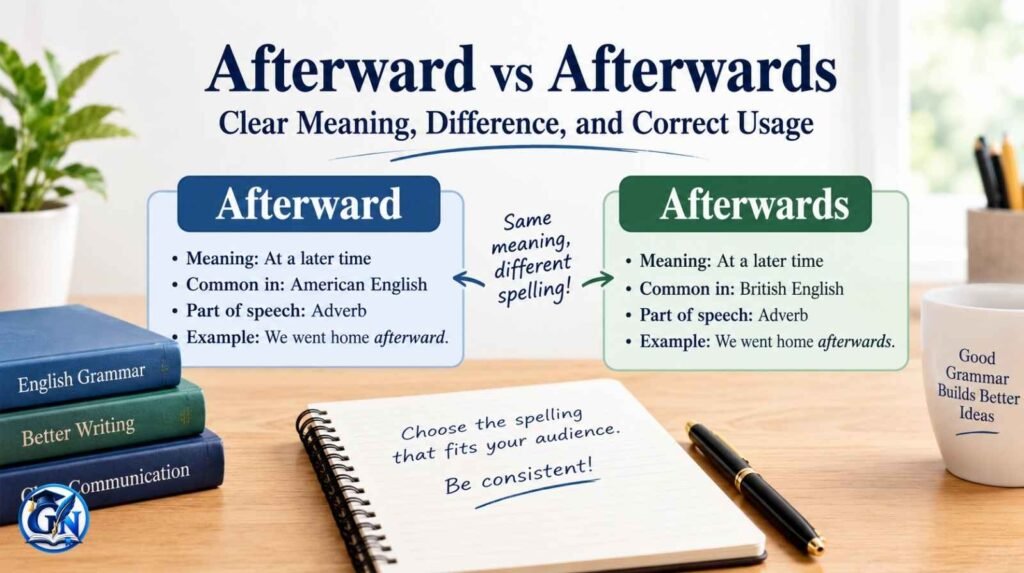
Have you ever wondered whether to write Afterward vs Afterwards? Both words are common in English, and they look almost identical. However, their usage can depend on which variety of English you speak or write.
The good news is that afterward and afterwards have the same meaning. Both refer to something that happens later or following a particular event. The main difference is regional preference: afterward is more common in American English, while afterwards is more common in British English.
In this guide, you will learn the meaning of each word, understand when to use it, explore practical examples, and discover simple ways to avoid spelling mistakes in your writing.
What Is the Difference Between Afterward and Afterwards?
The primary difference between afterward and afterwards is their spelling and regional usage, not their meaning. Both words are adverbs that describe something happening after an event, action, or period.
Meaning of Afterward
Afterward means at a later time or after something has happened. It is especially common in American English and is widely accepted in formal and informal writing.
Examples:
- We went to the library and had lunch afterward.
- She finished her exam and called her parents afterward.
- The team celebrated afterward because they had won the match.
- I will explain the details afterward.
In each sentence, afterward tells the reader that another action happens later.
Meaning of Afterwards
Afterwards has exactly the same meaning as afterward. It is especially common in British English and is also used in other varieties of English.
Examples:
- We visited the museum and went shopping afterwards.
- He apologized afterwards for his rude behavior.
- They watched a movie and discussed it afterwards.
- She completed her homework and played outside afterwards.
These examples communicate the same ideas as the sentences using afterward.
Afterward vs Afterwards at a Glance
| Feature | Afterward | Afterwards |
|---|---|---|
| Meaning | At a later time | At a later time |
| Part of speech | Adverb | Adverb |
| Common preference | American English | British English |
| Correct spelling | Yes | Yes |
| Formal writing | Appropriate | Appropriate |
| Informal writing | Appropriate | Appropriate |
| Example | We ate afterward. | We ate afterwards. |
Quick answer: Both spellings are correct. Choose afterward for a consistent American English style and afterwards for a consistent British English style.
When Should You Use Afterward?
Use afterward when describing an action that happens after another event. This spelling is particularly suitable for American English articles, academic assignments, business emails, and everyday communication.
Use Afterward in American English
American English generally favors the shorter form afterward. If you are writing for an American audience, this is usually the safest choice.
Examples:
- We attended the meeting and discussed the results afterward.
- The doctor examined the patient and spoke with the family afterward.
- I will send you the report afterward.
- She moved to Chicago and found a job shortly afterward.
Notice that afterward does not require an additional preposition when it is used in these sentences.
Use Afterward in Formal and Professional Writing
Although both spellings are acceptable, using afterward can help maintain a consistent American English style in professional communication.
For example:
Less consistent American English style: We reviewed the proposal afterwards and sent our feedback later.
More consistent American English style: We reviewed the proposal afterward and sent our feedback later.
The first sentence is not grammatically wrong. The second simply follows the more common American English preference.
Use Afterward to Describe a Sequence of Events
You can use afterward to show what happened next in a story, report, or personal experience.
Examples:
- The company introduced a new policy and evaluated its effects afterward.
- The students completed the experiment and recorded their observations afterward.
- We visited our grandparents and returned home afterward.
In each example, afterward makes the sequence of events clear.
When Should You Use Afterwards?
Use afterwards when describing something that happens later, particularly when writing in British English. The word is common in British publications, personal writing, and everyday conversations.
Use Afterwards in British English
British English generally favors afterwards, although afterward is also understood and accepted.
Examples:
- We went for a walk and had tea afterwards.
- She finished her work and went home afterwards.
- They visited London and traveled to Manchester afterwards.
- He spoke to his teacher afterwards about the assignment.
For British English content, afterwards is a natural choice.
Use Afterwards in Everyday Conversations
The word works well when talking about plans, experiences, and events.
Examples:
- Let’s grab something to eat afterwards.
- I’ll call you afterwards.
- We can talk about the problem afterwards.
- They went swimming and rested afterwards.
These sentences sound natural in ordinary conversation.
Use Afterwards in British English Articles
If your audience primarily reads British English, using afterwards can help your article maintain a consistent spelling style.
For example:
- The researchers reviewed the results afterwards.
- The author explained the decision afterwards.
- The students discussed the lesson afterwards.
Remember that the difference is a matter of regional preference rather than grammatical correctness.
Afterward vs Afterwards: Common Mistakes to Avoid
Although both words are correct, writers sometimes confuse them with similar expressions or assume that one spelling is incorrect.
Mistake 1: Thinking One Spelling Is Wrong
Incorrect assumption: Afterwards is always wrong in American English.
Correct understanding: Afterwards is a valid English word. However, afterward is generally preferred in American English.
Likewise, afterward is not incorrect in British English.
Mistake 2: Confusing Afterward With After a While
Both expressions can refer to a later time, but they are not always interchangeable in tone or context.
Examples:
- We ate dinner and went for a walk afterward.
- We ate dinner and went for a walk after a while.
The first sentence means the walk happened following dinner. The second suggests that some time passed before the walk began.
Mistake 3: Using Afterward as an Adjective
Afterward and afterwards are adverbs, not normally adjectives placed directly before a noun.
Incorrect: We discussed the afterward meeting.
Correct: We discussed the meeting afterward.
If you want to describe something that happens later, you may need a different word or phrase, depending on your intended meaning.
Mistake 4: Using Both Spellings Inconsistently
Switching between the two spellings within the same article can make your writing look inconsistent.
For example:
- We visited the park afterward.
- We went to a restaurant afterwards.
- We returned home afterward.
Although these sentences are individually correct, choosing one spelling throughout the article creates a more consistent style.
A Real-Life Example: Choosing Afterward or Afterwards
Imagine that Zia is writing an English grammar article for an educational website. His readers include students, teachers, and people learning English as a second language. He wants to explain the difference between afterward and afterwards without confusing readers.
First, he identifies his primary audience. Because the article focuses on American English spelling and usage, he chooses afterward as the preferred spelling.
He writes:
“Students should review their answers afterward to identify mistakes and improve their understanding.”
The sentence is clear and grammatically correct. It tells students to review their answers after completing an activity.
Next, Zia considers writing another version of the article for a British audience. He changes the sentence to:
“Students should review their answers afterwards to identify mistakes and improve their understanding.”
The meaning remains exactly the same. Only the preferred regional spelling changes.
Now imagine that a reader asks whether the British version is incorrect. Zia explains that both spellings are standard English. The choice depends on the publication’s preferred variety of English, not on a difference in grammar or meaning.
This example demonstrates an important lesson for writers: understanding your audience is often more useful than memorizing a rigid rule. If you write for American readers, afterward is a sensible default. If you write for British readers, afterwards may sound more familiar.
For bloggers, students, editors, and professional writers, consistency is the key. Choosing one spelling based on your audience helps readers focus on your message instead of wondering whether a spelling change was intentional.
Afterward vs Afterwards: Examples and Quick Usage Guide
The easiest way to remember the difference is to understand that both words describe a later action or event. Use the following examples to practice their meaning.
Example Sentences With Afterward
- We finished our lunch and went shopping afterward.
- She studied for three hours and watched television afterward.
- The manager reviewed the documents and contacted the client afterward.
- He visited his friend and returned home afterward.
- The teacher explained the lesson and answered questions afterward.
Example Sentences With Afterwards
- We finished our lunch and went shopping afterwards.
- She studied for three hours and watched television afterwards.
- The manager reviewed the documents and contacted the client afterwards.
- He visited his friend and returned home afterwards.
- The teacher explained the lesson and answered questions afterwards.
A Simple Step-by-Step Guide
Follow these three steps whenever you are unsure which spelling to choose.
- Identify your audience. Determine whether you are writing primarily for American or British English readers.
- Choose your preferred spelling. Use afterward for a typical American English style or afterwards for a typical British English style.
- Check consistency. Use the same spelling throughout your article, essay, or document unless you have a specific reason to preserve a different spelling.
This simple approach works for blog posts, school assignments, professional emails, and other forms of writing.
Are There Any Recent Statistics About Afterward vs Afterwards?
There is no single authoritative 2025–2026 statistic that establishes a universal percentage for how often English speakers use afterward compared with afterwards. The difference is mainly a question of regional language preference, and reliable frequency estimates depend on the corpus, publication type, and time period being studied.
How Can You Research Word Frequency?
You can investigate the relative frequency of both spellings through established linguistic resources.
- Google Books Ngram Viewer: Explore historical usage patterns in the books included in its database.
- Cambridge Dictionary: Check definitions, grammatical information, and examples of standard English usage.
- Merriam-Webster: Consult an established American English dictionary for spelling and meaning.
These resources help you understand usage, but they measure different things. For example, book frequency does not necessarily represent how people write in text messages, emails, or social media posts in 2026.
What Does the Available Evidence Tell Us?
The established distinction remains straightforward: afterward is more common in American English, while afterwards is more common in British English. Both are accepted forms.
For an accurate numerical comparison, select a suitable, clearly dated corpus and compare the two spellings using the same search conditions. Avoid presenting an unsupported percentage as a verified 2025 or 2026 statistic.
FAQs
Q1: Is afterward or afterwards correct?
A: Both are correct. They have the same meaning and function as adverbs. Afterward is generally preferred in American English, while afterwards is more common in British English.
Q2: Is afterward American or British English?
A: Afterward is especially common in American English. However, British English speakers also use it, and it is not grammatically incorrect in British writing.
Q3: Is afterwards British English?
A: Yes, afterwards is particularly common in British English. It is also used in other varieties of English and is accepted in American English.
Q4: Do afterward and afterwards mean the same thing?
A: Yes. Both mean “at a later time” or “after an event.” For example, “We ate afterward” and “We ate afterwards” communicate the same idea.
Q5: Which spelling should I use in an essay?
A: Follow the spelling convention required by your teacher, university, publisher, or style guide. If no preference is specified, choose one form and use it consistently.
Q6: Can I use afterwards in American English?
A: Yes. Afterwards is a valid word in American English, although afterward is generally the more common American preference.
Q7: Is afterward one word or two?
A: Afterward is one word. It does not need a space or hyphen. The same is true of afterwards.
Q8: What is another word for afterward or afterwards?
A: Depending on the sentence, alternatives include later, subsequently, and following that. For example, “We finished the meeting and left afterward” can become “We finished the meeting and left later.”
Conclusion:
The difference between afterward vs afterwards is simple: both words mean that something happens later, but they reflect different regional preferences.
Use afterward when writing primarily for an American English audience. Choose afterwards when writing for a British English audience. Neither spelling is universally wrong, and both work in formal and informal contexts.
The most important rule is to understand your audience and remain consistent throughout your writing. Once you know this distinction, choosing the correct form becomes easy.
👉 Explore more useful grammar tips and guides on Gramnora

Explore the world of English grammar with simple explanations, practical examples, and easy-to-follow guides by Zia Tarar, the founder and author of Gramnora. From essential grammar rules and sentence structure to common mistakes and advanced concepts, Gramnora helps learners improve their English, strengthen their writing skills, and communicate with greater clarity and confidence.