
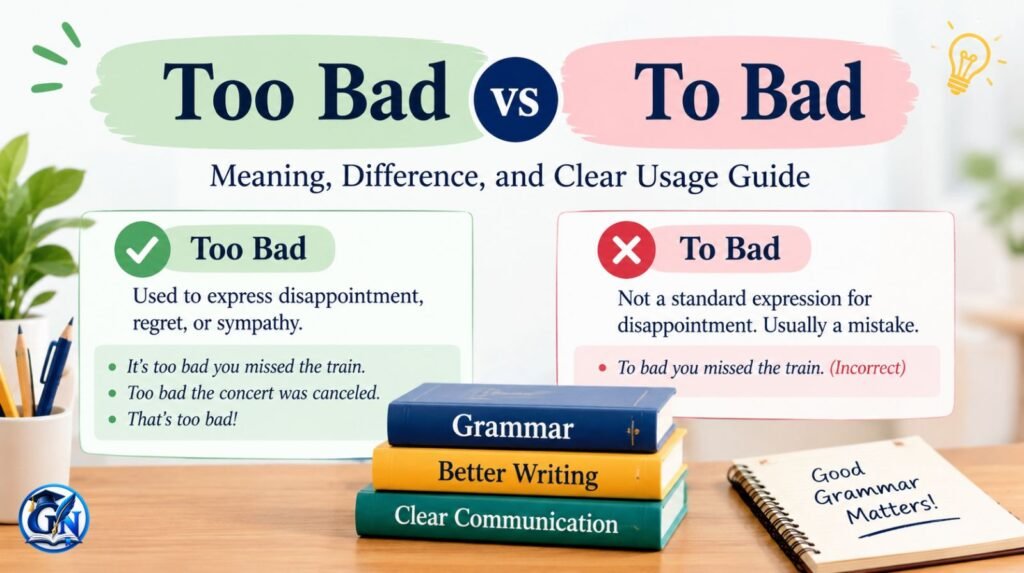
Have you ever wondered whether to write “Too Bad vs To Bad” in a sentence? These expressions look almost identical, but only one is correct in standard English when you want to express disappointment, regret, or sympathy. Choosing the wrong form can make your writing look less polished, especially in emails, school assignments, blog posts, and professional communication.
The difference between too bad vs to bad is simple once you understand how the word too works. “Too bad” is the correct expression when describing something unfortunate or disappointing. The phrase “to bad” is generally incorrect when used with this meaning, although the words to and bad can appear next to each other in certain grammatical constructions.
In this guide, you will learn the meanings, grammar rules, common mistakes, real-life examples, and easy ways to remember which expression to use.
Too Bad vs To Bad: What Is the Difference?
The main difference between too bad and to bad is the meaning and grammatical function of the word too.
- Too bad: A correct expression used to describe something unfortunate, disappointing, or regrettable.
- To bad: Not a standard expression for expressing disappointment. It is usually a spelling or grammar mistake when used in place of too bad.
For example:
- Correct: “Too bad you couldn’t attend the party.”
- Incorrect: “To bad you couldn’t attend the party.”
In the first sentence, too bad expresses disappointment about someone’s absence. The second sentence uses the wrong word.
What Does “Too Bad” Mean?
“Too bad” is a common English expression that can communicate disappointment, sympathy, or regret. Its exact tone depends on the situation and how the speaker says it.
Examples:
- “It’s too bad that the concert was canceled.”
- “Too bad you missed the last train.”
- “That’s too bad! I hope things get better soon.”
In everyday conversation, the expression may be sympathetic or casual. However, depending on tone, it can sometimes sound dismissive or sarcastic.
Why Is “To Bad” Usually Incorrect?
The word to is commonly used before a verb to form an infinitive, as in “to read,” “to write,” or “to learn.” It does not replace too in the expression too bad.
Examples:
- Incorrect: “It is to bad that we lost.”
- Correct: “It is too bad that we lost.”
Remember that too expresses an idea such as “more than necessary” or forms part of expressions such as too bad. The word to serves different grammatical purposes.
Quick Comparison Table
| Feature | Too Bad | To Bad |
|---|---|---|
| Standard expression for disappointment | Yes | No |
| Correct in “It’s ___ you missed it” | Too bad | Incorrect |
| Main grammatical role | Adverb too + adjective bad | Preposition or infinitive marker to + adjective |
| Common usage | Conversation and writing | Usually a mistake in this expression |
| Example | “Too bad about the weather.” | “To bad about the weather.” (incorrect) |
Meaning and Usage of “Too Bad”
Understanding how too bad works will help you use it naturally in conversations and written English.
1. Expressing Disappointment
The most common use of too bad is to express disappointment when something does not happen as expected.
Examples:
- “It’s too bad that the store is closed.”
- “Too bad we couldn’t get tickets to the game.”
- “It’s too bad she had to leave early.”
In each example, the speaker expresses regret about an unwanted situation.
2. Showing Sympathy
You can also use too bad to acknowledge another person’s difficulty or disappointment.
Examples:
- “You lost your wallet? That’s too bad.”
- “It’s too bad your flight was delayed.”
- “Too bad you’re feeling unwell. I hope you recover soon.”
In these situations, the expression acknowledges a problem. If you want to sound especially caring, add a supportive sentence such as “I’m sorry that happened.”
3. Using “Too Bad” Sarcastically
Sometimes, people use too bad to show that they are not concerned about another person’s problem.
Examples:
- “You didn’t save a seat? Too bad!”
- “You missed the deadline. Too bad.”
- “You don’t like the rules? That’s too bad.”
The meaning depends on context, facial expression, and tone. In professional or sensitive situations, consider using a more considerate phrase to avoid sounding rude.
How to Use “Too Bad” Correctly in Sentences
The easiest way to use too bad correctly is to identify whether you are describing an unfortunate situation or expressing disappointment.
Common Sentence Patterns
Here are three useful patterns:
Pattern 1: It’s too bad that + sentence
- “It’s too bad that the event was postponed.”
- “It’s too bad that he couldn’t join us.”
Pattern 2: Too bad + sentence
- “Too bad you missed the announcement.”
- “Too bad we arrived late.”
Pattern 3: That’s too bad
- “My laptop stopped working.” “That’s too bad.”
- “I couldn’t attend the meeting.” “That’s too bad.”
These patterns are common in everyday English and are easy to remember.
A Simple Trick to Remember the Difference
Use this memory trick:
If you mean “unfortunate” or “disappointing,” write “too bad.”
You can also compare too with also or excessively. Although these words are not interchangeable in every sentence, the comparison can remind you that too is different from to.
Examples:
- “It’s too bad we missed the bus.” — Correct.
- “The bag is too heavy.” — Correct.
- “I want to go to school.” — Correct use of to.
Common Mistakes to Avoid
| Incorrect sentence | Correct sentence |
|---|---|
| It is to bad that you left. | It is too bad that you left. |
| To bad we missed the show. | Too bad we missed the show. |
| That’s to bad for him. | That’s too bad for him. |
| It’s to bad about the weather. | It’s too bad about the weather. |
A quick proofreading check can help you catch these errors before publishing an article, sending an email, or submitting an assignment.
Real-Life Example: Using “Too Bad” in Everyday Communication
Imagine that a student named Alex has been preparing for an important school presentation for several days. He creates slides, practices his speech, and asks a friend to review his work. On the morning of the presentation, however, heavy rain causes transportation delays, and Alex arrives after his class has finished presenting.
When Alex tells his classmate Mia what happened, she might respond, “That’s too bad! You worked really hard on that presentation.”
Here, Mia uses too bad to express sympathy and acknowledge Alex’s disappointment. Her response is grammatically correct and sounds natural in an informal conversation.
Now imagine that Alex writes a message to his teacher: “It’s to bad that I arrived late because of the rain.” The meaning is understandable, but the spelling is incorrect. The appropriate sentence is, “It’s too bad that I arrived late because of the rain.”
For a more professional message, Alex could write, “I’m sorry I arrived late because of the transportation delays. I regret missing my presentation and would appreciate the opportunity to discuss whether I can make it up.”
This example demonstrates two important lessons. First, too bad is the standard expression for disappointment or regret. Second, although the expression is useful in casual conversation, a more specific and polite sentence may be better for formal communication.
Grammar Rules Behind “Too” and “To”
Learning the grammatical difference between too and to makes this spelling choice easier.
When to Use “Too”
Too is an adverb. It commonly means “also” or “more than is necessary.” It also appears in established expressions such as too bad.
Examples:
- “I want to come too.” — Also.
- “The coffee is too hot.” — More hot than desired.
- “It’s too bad we missed the train.” — An expression of disappointment.
When to Use “To”
To commonly functions as a preposition or as the marker of an infinitive verb.
Examples:
- “She went to the library.”
- “I need to study.”
- “He gave the letter to his friend.”
However, the words to and bad can occur next to each other in a longer grammatical construction.
For example: “I went to Bad Harzburg last summer.”
In this sentence, to is a preposition and Bad Harzburg is a place name. Therefore, it is not the incorrect expression to bad used to communicate disappointment.
Another example is “I tried to bad-mouth nobody,” although this sentence is awkwardly phrased. A clearer version would be “I tried not to bad-mouth anyone.” Here, to belongs to the infinitive phrase, and bad-mouth is a verb.
The key lesson is that you should consider the complete sentence rather than judging two adjacent words in isolation.
FAQs
Q1: Is “too bad” or “to bad” correct?
A: “Too bad” is correct when expressing disappointment, sympathy, or regret. “To bad” is generally incorrect when used with that meaning.
Example: “It’s too bad that the game was canceled.”
Q2: What does “too bad” mean?
A: “Too bad” is an expression used to describe an unfortunate or disappointing situation. Depending on the context, it can also express sympathy or sound sarcastic.
Example: “Too bad you couldn’t come to dinner.”
Q3: Why do people write “to bad” instead of “too bad”?
A: People often confuse the words because they sound alike in many varieties of English. This is a common spelling mistake involving homophones words that sound the same but have different meanings or spellings.
Q4: Can “to bad” ever be grammatically correct?
A: Yes, the words to and bad can appear next to each other in a sentence when they have separate grammatical functions. For example, “We traveled to Bad Ischl.” Here, Bad Ischl is a place name. However, “to bad” is not the correct expression for disappointment.
Q5: Is “too bad” formal or informal?
A: “Too bad” is generally conversational and informal. It is perfectly natural in everyday speech and casual writing. For formal emails or professional communication, phrases such as “Unfortunately,” “I regret that,” or “I’m sorry to hear that” may be more appropriate.
Q6: Does “too bad” always express sympathy?
A: No. It can express disappointment, regret, or sympathy, but it can also sound dismissive or sarcastic.
For example, “That’s too bad” may be sympathetic when spoken warmly but dismissive when delivered coldly.
Q7: What is an easy way to remember “too bad”?
A: Remember this rule: Use “too bad” when you mean unfortunate or disappointing. Use to for purposes such as indicating direction or introducing an infinitive verb.
Example: “It’s too bad we have to go.”
Q8: Is “too bad” one word or two words?
A: “Too bad” is written as two separate words. Too modifies bad in the expression, so do not combine them into “toobad” or replace too with to.
Conclusion:
When comparing too bad vs to bad, the correct choice depends on what you want to express. If you are talking about something unfortunate, disappointing, or regrettable, use too bad. The phrase “to bad” is not the standard spelling for this expression, although to can appear before bad in other grammatical contexts.
Remember these simple examples:
- “It’s too bad that we missed the train.”
- “That’s too bad! I hope you feel better.”
- “I need to go to the store.”
The more you read and practice, the easier it becomes to recognize the difference between too, to, and two.
👉 Explore more useful grammar tips and guides on Gramnora

Explore the world of English grammar with simple explanations, practical examples, and easy-to-follow guides by Zia Tarar, the founder and author of Gramnora. From essential grammar rules and sentence structure to common mistakes and advanced concepts, Gramnora helps learners improve their English, strengthen their writing skills, and communicate with greater clarity and confidence.