
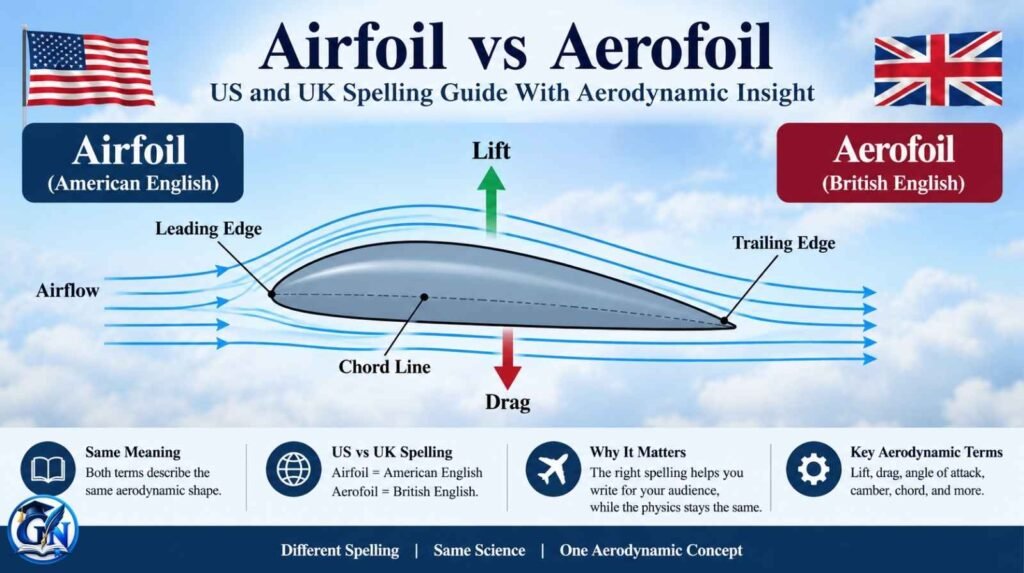
If you have ever wondered whether airfoil vs aerofoil represents two different aerodynamic concepts, you are not alone. The two words look different, but the good news is that they generally describe the same type of aerodynamic shape. The main difference is where the spelling is used.
Airfoil is the standard spelling in American English, while aerofoil is the traditional British English spelling. Cambridge identifies airfoil as US English and aerofoil as UK English.
In this guide, you will learn which spelling to use, why the words differ, how an airfoil or aerofoil works, and how aerodynamic concepts such as lift, drag, and angle of attack relate to the term.
Airfoil vs Aerofoil: Are They the Same Thing?

Yes. In ordinary aviation and engineering usage, airfoil and aerofoil refer to the same basic aerodynamic concept.
In American English, airfoil is the preferred spelling.
For example:
- The aircraft has a highly efficient airfoil design.
- Engineers tested the new airfoil in a wind tunnel.
- The wing uses a specially designed airfoil profile.
Cambridge labels airfoil as a US English term and gives aerofoil as the UK equivalent.
The word is especially common in American aviation, aerospace engineering, textbooks, and technical documentation.
Aerofoil Is the British English Spelling
In British English, aerofoil is the preferred spelling.
For example:
- The aircraft uses a modern aerofoil section.
- Engineers studied the aerofoil’s aerodynamic performance.
- The wing has a carefully designed aerofoil profile.
The UK Civil Aviation Authority also uses aerofoil in its aviation training and technical material, including discussions of aerofoil sections, chord, camber, angle of attack, and airflow.
Quick Answer
| Term | Standard variety | Example |
|---|---|---|
| airfoil | American English | The wing has an efficient airfoil. |
| aerofoil | British English | The wing has an efficient aerofoil. |
| Meaning | Essentially the same | An aerodynamic profile designed to interact with airflow |
Therefore, neither spelling is inherently “wrong.” Your choice should depend mainly on your target variety of English.
What Is an Airfoil or Aerofoil in Aerodynamics?

An airfoil or aerofoil is a shaped body or cross-section designed to produce a useful aerodynamic effect as air flows around it.
An airfoil can be part of an aircraft wing, propeller blade, rotor blade, or other aerodynamic component.
When air flows around the shape, the air is redirected and the pressure distribution around the surface produces aerodynamic forces. NASA explains that lift can be produced when an object turns a flow of air, and that both the upper and lower surfaces of an airfoil contribute to this flow turning.
This is important because the common simplified idea that lift happens simply because air traveling over the longer upper surface “has to meet” the lower airflow at the trailing edge is not an accurate explanation. NASA specifically identifies that as a misleading theory. (NASA)
Lift and Drag Work Together
An airfoil does not produce only lift. It also experiences drag.
NASA describes lift as acting perpendicular to the flight path, while drag acts in the direction opposing the aircraft’s motion. Both forces depend on factors such as aircraft shape, size, air conditions, and velocity.
A useful relationship is:
L = ½ρV²ACl
where:
- L = lift
- ρ = air density
- V = velocity
- A = reference area
- Cl = lift coefficient
So, when engineers design an airfoil, they are not simply trying to create “as much lift as possible.” They also need to consider drag, speed, stability, efficiency, and the intended operating conditions.
Airfoil vs Aerofoil: Which Spelling Should You Use?

The easiest way to choose is to match the spelling to your audience.
Choose airfoil when your content follows American English conventions.
Examples include:
- American aviation articles
- US engineering documents
- American university assignments
- US aerospace websites
- Technical material intended primarily for American readers
Example:
The engineer modified the airfoil to reduce drag at cruising speed.
Use Aerofoil in British English
Choose aerofoil when writing in British English.
Examples include:
- UK aviation documents
- British engineering publications
- UK educational material
- British English websites
- Technical writing intended for a UK audience
Example:
The engineer modified the aerofoil to reduce drag at cruising speed.
The UK Civil Aviation Authority’s terminology provides a useful real-world example: its training material refers to the aerofoil section and related aerodynamic characteristics.
A Simple Spelling Rule
Think of it this way:
American English → airfoil
British English → aerofoil
The difference is mainly orthographic, not a difference in aerodynamic technology.
2025–2026 Airfoil and Aerofoil Usage: What Current Sources Show
Current authoritative material continues to show the same US/UK distinction rather than treating the terms as two different aerodynamic objects.
| Source/current material | Term used | What it tells us |
|---|---|---|
| Cambridge Dictionary, current listing | airfoil | Identified as US English |
| Cambridge Dictionary, current listing | aerofoil | Identified as UK English |
| FAA Pilot’s Handbook, 2026 edition | airfoil | US aviation terminology |
| UK CAA aviation material | aerofoil | UK aviation terminology |
| NASA aerodynamics resources | airfoil | US technical/aerospace terminology |
The FAA’s current Pilot’s Handbook material discusses airfoil design, including how different airfoil shapes influence flight characteristics and why an aircraft’s requirements determine the appropriate design.
The UK CAA’s aviation material, meanwhile, uses aerofoil when discussing aerofoil sections and airflow.
This makes the spelling distinction particularly useful for writers: current technical usage in 2025–2026 still reflects the regional difference rather than a change in meaning.
A Useful Aerodynamic Data Point
NASA’s aerodynamic reference material gives a typical drag coefficient of about 0.045 for an airfoil under the conditions represented in its example, compared with much larger values for less streamlined shapes. NASA notes that such coefficients come from experimental measurements and depend on flow conditions and reference area. (NASA)
That number should not be treated as a universal value for every airfoil. Airfoil performance varies with geometry, Reynolds number, Mach number, angle of attack, and other conditions.
A Real-Life Example: The Wright Brothers and Airfoil Design
A fascinating real-world example comes from the early development of powered flight. The Wright brothers did not simply build a wing based on appearance and hope that it would work. They investigated wing shapes experimentally and developed a wind tunnel to test aerodynamic designs.
NASA’s historical aerodynamics material notes that the Wright brothers tested small wing models in their wind tunnel in 1901. Their resulting airfoils were relatively thin and had slight camber, with both upper and lower surfaces curved.
This example helps explain why the word airfoil represents more than just the outline of an aircraft wing. Engineers care about the exact geometry of the profile because relatively small changes in shape can influence lift and drag.
The Wright brothers’ work is also useful for understanding why modern explanations of lift need care. Their early airfoils did not depend on the simplistic idea that the upper surface had to be longer than the lower surface. NASA points out that the upper and lower surfaces of the Wright 1903 airfoil were nearly the same length, yet the design still generated substantial lift.
Today, engineers can use advanced computational methods and wind-tunnel testing to evaluate airfoil performance for specific aircraft. The fundamental lesson remains the same: airfoil geometry matters because it determines how the airflow interacts with the surface.
So, whether an American engineer writes airfoil or a British engineer writes aerofoil, they can be discussing essentially the same aerodynamic principle.
Key Aerodynamic Terms Related to Airfoil and Aerofoil

Understanding a few related terms makes the airfoil vs aerofoil distinction much easier.
The angle of attack is the angle between an airfoil’s chord line and the incoming airflow.
Changing this angle affects lift and drag. At sufficiently high angles, airflow can separate from the surface, producing a stall condition.
NASA explains that increasing angle of attack can cause drag to rise significantly, while flow separation at higher angles can make lift and drag highly unsteady.
Camber
Camber describes the curvature of an airfoil.
Different amounts and distributions of camber can be selected for different aerodynamic purposes. NASA’s wing geometry material explains that camber is a measure of the curvature of the airfoil and that airfoils can have many combinations of camber and thickness distributions.
Chord
The chord is the straight-line reference connecting the leading edge and trailing edge of an airfoil section.
Engineers use chord when describing other properties, such as thickness-to-chord ratio and aerodynamic geometry.
Drag
Drag is the aerodynamic force that opposes motion through the air.
Airfoil shape can strongly influence drag. NASA notes that drag depends on shape, size, inclination, and flow conditions.
Lift-to-Drag Ratio
The lift-to-drag ratio (L/D) is an important measure of aerodynamic efficiency.
NASA explains that a higher L/D ratio indicates that an aircraft produces a relatively large amount of lift for the amount of drag generated.
Airfoil vs Aerofoil: Easy Comparison Checklist
If you are still unsure which spelling to choose, use this checklist:
- Writing for the United States? Use airfoil.
- Writing for the United Kingdom? Use aerofoil.
- Writing for an international audience? Either can work, but choose one English variety and stay consistent.
- Writing about US aviation sources? Preserve airfoil when referring to their terminology.
- Writing about UK aviation sources? Preserve aerofoil when quoting or discussing their terminology.
- Talking about the aerodynamic concept? Both terms generally refer to the same type of aerodynamic profile.
- Writing SEO content? Naturally mention both terms once or twice when useful, rather than repeatedly forcing both spellings into every paragraph.
One-Sentence Memory Trick
Airfoil = American English; Aerofoil = British English.
That simple rule will solve most spelling questions.
FAQs
Q1: Is airfoil or aerofoil correct?
A: Both are correct. Airfoil is the standard American English spelling, while aerofoil is the standard British English spelling. They generally refer to the same aerodynamic concept.
Q2: Is aerofoil British or American?
A: Aerofoil is British English. American English normally uses airfoil. Cambridge explicitly labels aerofoil as UK English and airfoil as US English.
Q3: Is airfoil the American spelling?
A: Yes. Airfoil is the standard American spelling. It is widely used in US aviation and aerospace terminology, including FAA publications.
Q4: Do airfoil and aerofoil mean the same thing?
A: In general, yes. The two words describe the same basic aerodynamic type of shape or profile. The primary difference is the regional spelling convention.
Q5: What does an airfoil do?
A: An airfoil interacts with moving air to generate aerodynamic forces, including lift and drag. Its geometry influences how the airflow is turned and how pressure is distributed around the surface.
Q6: Is an aircraft wing an airfoil?
A: A wing is a three-dimensional aerodynamic structure, while an airfoil usually refers to the cross-sectional profile of an aerodynamic surface. Therefore, it is more precise to say that a wing has an airfoil section or airfoil profile.
Q7: Does aerofoil only refer to aircraft?
A: No. Aerofoils can be found in other aerodynamic applications, including propeller and rotor blades. The term refers to the aerodynamic shape rather than exclusively to a complete aircraft wing.
Q8: Which spelling should I use in an SEO article?
A: Use the spelling that matches your target audience. For US readers, use airfoil as the main form. For UK readers, use aerofoil. If you are targeting both audiences, naturally include both terms while making your regional preference clear.
Conclusion:
The difference between airfoil vs aerofoil is much simpler than it first appears.
Airfoil is the preferred American English spelling, while aerofoil is the British English spelling. Both generally describe an aerodynamic profile designed to interact with airflow and produce useful aerodynamic forces such as lift.
The spelling does not change the underlying aerodynamics. Whether you are reading about an airfoil in an FAA document or an aerofoil in UK aviation material, the important concepts remain the same: lift, drag, airflow, camber, chord, angle of attack, and aerodynamic efficiency. Current Cambridge, FAA, UK CAA, and NASA materials all reinforce this distinction.
So remember:
US English: airfoil
UK English: aerofoil
If you are unsure which spelling to use, simply identify your audience first and then stay consistent throughout your writ
👉Discover more simple and practical grammar guides on Gramnora

Explore the world of English grammar with simple explanations, practical examples, and easy-to-follow guides by Zia Tarar, the founder and author of Gramnora. From essential grammar rules and sentence structure to common mistakes and advanced concepts, Gramnora helps learners improve their English, strengthen their writing skills, and communicate with greater clarity and confidence.