
Have you ever wondered whether the correct spelling is humorous or humerous? You are not alone. These two spellings look almost identical, and the pronunciation can make the difference even harder to notice.
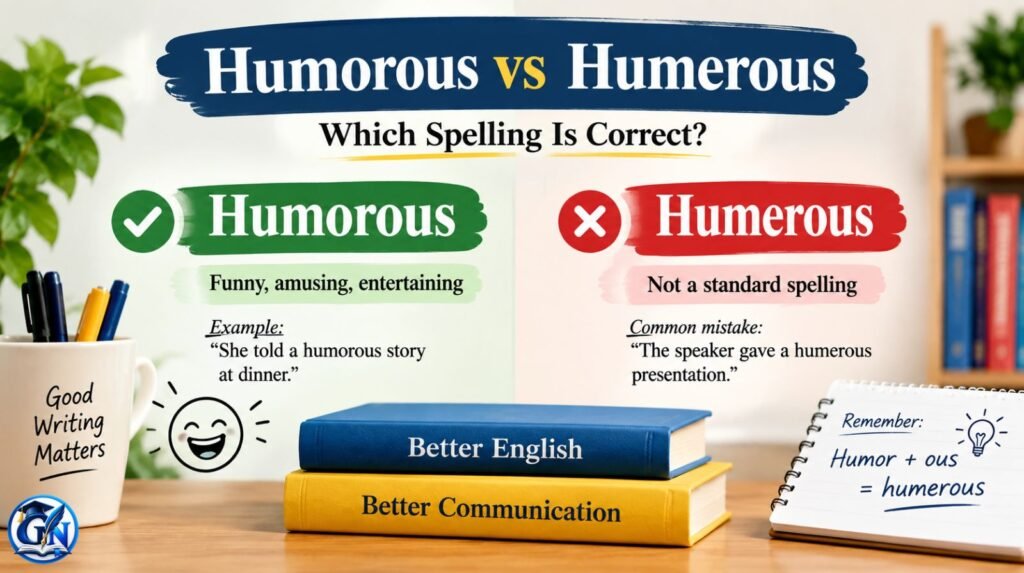
The correct spelling is humorous. The word humerous is a common spelling mistake and is not the standard spelling of the adjective meaning “funny” or “amusing.”
In this guide, we will explain humorous vs humerous, their meanings, correct usage, examples, and a simple trick to remember the right spelling.
Humorous vs Humerous: Which One Is Correct?
The correct spelling is humorous, with “o” after the “m.”
Humorous means funny, amusing, or likely to make people laugh. Humerous, when someone intends to use it as the adjective meaning “funny,” is a misspelling.
The Correct Spelling: Humorous
Humorous is the standard English spelling.
For example:
- She told a humorous story at dinner.
- His humorous writing makes the article enjoyable.
- The teacher gave a humorous example to explain the lesson.
The Incorrect Spelling: Humerous
Humerous is commonly written by mistake when people confuse the spelling with the pronunciation.
For example:
Incorrect: The speaker gave a humerous presentation.
Correct: The speaker gave a humorous presentation.
So, if you mean “funny” or “amusing,” always choose humorous.
What Does Humorous Mean?
The adjective humorous describes something that is funny, amusing, or intended to make people laugh.
Humorous Meaning
According to standard English usage, humorous can describe a person, comment, story, situation, article, or piece of writing that contains or expresses humor.
For example:
- a humorous novel
- a humorous speech
- a humorous character
- a humorous comment
- a humorous advertisement
The word comes from humor, which refers to the quality of being amusing or entertaining.
Humorous in a Sentence
Here are some natural examples:
- Mark gave a humorous answer during the interview.
- The book contains several humorous stories.
- Her humorous personality makes people feel comfortable.
- The writer uses humorous examples to explain difficult ideas.
- It was a serious meeting, but his humorous comment made everyone smile.
Why Is “Humerous” a Common Mistake?
The spelling humerous can look reasonable because English spelling does not always perfectly match pronunciation.
Pronunciation Can Cause Confusion
When people hear humorous, they may not clearly hear every vowel sound. As a result, they sometimes spell the word as humerous.
This is especially common among English learners because the pronunciation can make the middle of the word less obvious.
Compare the Two Spellings
| Spelling | Correct? | Meaning |
|---|---|---|
| Humorous | ✅ Yes | Funny or amusing |
| Humerous | ❌ No, for this meaning | Common misspelling |
A useful rule is simple:
If you mean funny or amusing, spell it “humorous.”
Humorous vs Humerous: Easy Examples
Seeing the words in context makes the difference easier to remember.
Correct Examples With Humorous
Humorous can describe something that makes people laugh or adds amusement.
- The movie has a humorous ending.
- She wrote a humorous blog post.
- His humorous personality made the conversation enjoyable.
- The comedian is known for his humorous observations.
- The teacher used a humorous example during the lesson.
Incorrect Examples With Humerous
These sentences contain the common spelling error:
- ❌ He wrote a humerous story.
- ❌ She made a humerous comment.
- ❌ It was a very humerous speech.
The corrected versions are:
- ✅ He wrote a humorous story.
- ✅ She made a humorous comment.
- ✅ It was a very humorous speech.
A Simple Memory Trick
Think of the word this way:
Humor + ous = humorous
The base word is humor, so remembering the “o” in humor can help you remember the spelling of humorous.
Humor → humorous
That connection is much easier than trying to memorize the entire word letter by letter.
A Real-Life Writing Example: How One Letter Changes the Word
Imagine a student is writing an English assignment about a favorite comedian. The student wants to say that the comedian makes audiences laugh and writes:
“The comedian is known for his humerous stories and funny observations.”
The meaning is easy to understand, but the spelling humerous is incorrect.
A teacher or editor would normally change the sentence to:
“The comedian is known for his humorous stories and funny observations.”
This small spelling correction matters because polished writing depends on both clear meaning and standard spelling.
The same issue can appear in blog posts, emails, school assignments, social media captions, and professional content. A reader may understand what the writer means, but an incorrect spelling can still make the writing look less polished.
The easiest way to prevent the mistake is to connect humorous with the noun humor. Whenever you want to describe something funny or amusing, start with humor and add -ous:
humor → humorous
This is especially useful for English learners because it creates a logical spelling pattern instead of relying only on pronunciation.
Humorous vs Humerous: Quick Comparison Checklist
Use this quick checklist whenever you are unsure.
Step-by-Step Check
Step 1: Ask what you want to say.
Do you mean funny, amusing, or entertaining?
Step 2: Think of the base word.
The base word is humor.
Step 3: Add the ending.
Humor + ous = humorous
Step 4: Check the spelling.
Make sure the word contains the “o” after hum.
Quick Rule
Humorous = correct spelling for “funny” or “amusing.”
Humerous = common misspelling.
This simple rule can help you avoid the mistake in everyday writing.
What Do Dictionaries Say About “Humorous”?
Major dictionaries recognize humorous as the standard English adjective meaning funny or amusing. For example, Merriam-Webster defines and documents humorous as an adjective related to humor. Cambridge Dictionary also lists humorous as the standard English form.
This dictionary evidence is useful because spelling questions are best answered using established English usage rather than relying only on pronunciation.
What About “Humerous”?
When humerous is intended to mean “funny,” it is generally a misspelling of humorous.
Therefore, in normal English writing, choose:
Humorous ✅
rather than:
Humerous ❌
Humorous vs Humerous: 2025–2026 Usage Perspective
Modern digital writing makes spelling accuracy increasingly important. In 2025–2026, people regularly write across websites, blogs, emails, online learning platforms, social media, and workplace communication. However, there is no reliable universal statistic showing that a specific percentage of writers misspell humorous as humerous.
That distinction matters: search engines and writing tools can reveal that a spelling mistake exists, but a search-result count should not automatically be treated as a scientifically representative spelling-error rate.
For authoritative spelling and meaning, dictionary resources remain the better reference. Google also provides guidance for creating helpful, reliable, people-first content rather than content written primarily to manipulate search rankings.
Why This Matters for Writers
If you publish online, correct spelling contributes to:
- Clear communication
- Reader confidence
- Professional presentation
- Better readability
- Stronger educational value
So while humerous may be understandable to readers, humorous is the spelling you should use in polished English.
FAQs
Q1: Is “humorous” the correct spelling?
A: Yes. Humorous is the correct spelling when you mean funny, amusing, or entertaining.
Q2: Is “humerous” a word?
A: Humerous is not the standard spelling of the adjective meaning “funny.” In most cases, it is simply a misspelling of humorous.
Q3: How do you spell humorous correctly?
A: Spell it H-U-M-O-R-O-U-S: humorous.
Q4: What does humorous mean?
A: Humorous means funny, amusing, or likely to make people laugh.
Q5: Why do people spell humorous as humerous?
A: The mistake is often caused by pronunciation. The middle sounds of humorous can make the spelling difficult to identify, especially for English learners.
Q6: What is an example of humorous?
A: Here is a simple example:
“She told a humorous story that made everyone laugh.”
Q7: Is humorous an adjective?
A: Yes. Humorous is an adjective because it describes a person, thing, story, comment, situation, or other noun.
Q8: What is the easiest way to remember humorous?
A: Connect it to the noun humor:
Humor → humorous
Remember the “o” in humor, and you are much less likely to write humerous by mistake.
Conclusion:
When choosing between humorous vs humerous, the answer is straightforward: humorous is the correct spelling when you mean funny or amusing.
The easiest way to remember it is to connect the word with humor:
Humor + ous = humorous.
Although humerous is a common spelling mistake, it should be avoided in formal writing, schoolwork, professional communication, and published content.
If you often confuse similar English spellings, keep this simple rule in mind: when something is funny, it is humorous not humerous.
👉 Discover more simple and practical grammar guides on Gramnora

Explore the world of English grammar with simple explanations, practical examples, and easy-to-follow guides by Zia Tarar, the founder and author of Gramnora. From essential grammar rules and sentence structure to common mistakes and advanced concepts, Gramnora helps learners improve their English, strengthen their writing skills, and communicate with greater clarity and confidence.