
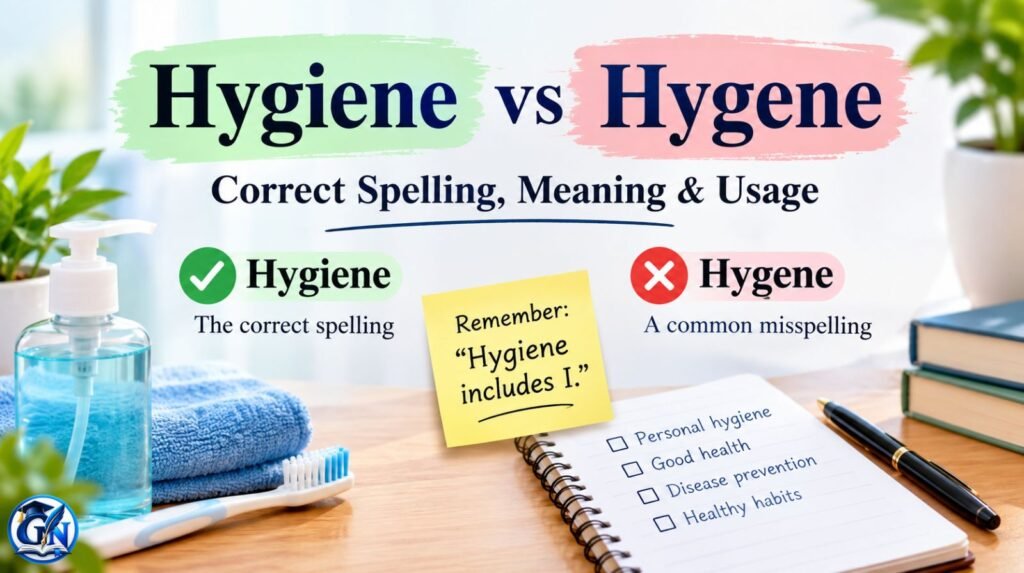
Have you ever typed “Hygiene vs Hygene” and wondered whether it is the correct spelling? You are not alone. Hygiene vs Hygene is a common spelling confusion because the word “hygiene” does not sound exactly the way it is spelled.
The correct spelling is hygiene. Hygene is a misspelling and should not be used in standard English.
In this guide, you will learn the meaning of hygiene, why “hygene” is incorrect, how to use hygiene in a sentence, common related words, and a simple trick to remember the correct spelling.
Hygiene vs Hygene: Which Spelling Is Correct?
Hygiene is the correct English spelling.
It is a noun that refers to practices or conditions related to keeping yourself and your surroundings clean, particularly to maintain health and help prevent disease. Cambridge Dictionary defines hygiene as the degree to which people keep themselves or their environment clean, especially to prevent disease.
Examples:
- Good hygiene is important for maintaining good health.
- Personal hygiene includes regular bathing and brushing your teeth.
- The restaurant follows strict food hygiene standards.
- Proper handwashing is an important part of good hygiene.
Hygene Is Incorrect
Hygene is not the standard spelling of the word.
If you write “hygene” in an essay, email, article, application, or other formal writing, it should be corrected to hygiene.
For example:
- ❌ Good hygene helps prevent illness.
- ✅ Good hygiene helps prevent illness.
Therefore, whenever you are choosing between hygiene vs hygene, choose hygiene.
What Does Hygiene Mean?
Hygiene means the practices and habits people follow to keep themselves and their surroundings clean and healthy.
It can include:
- Washing your hands
- Brushing your teeth
- Bathing regularly
- Wearing clean clothes
- Keeping food preparation areas clean
- Cleaning frequently touched surfaces
- Maintaining clean living spaces
The word can describe both personal cleanliness and cleanliness in environments such as homes, workplaces, hospitals, restaurants, and schools.
Hygiene Pronunciation
The word hygiene is commonly pronounced approximately like:
HY-jeen
Cambridge gives the pronunciation as /ˈhaɪ.dʒiːn/ in British and American English.
The unusual spelling can make the word difficult to remember. That is one reason people sometimes write hygene instead.
Example Sentences With Hygiene
Here are several natural examples:
- Good personal hygiene can help you feel fresh and comfortable.
- Children should learn about hygiene from an early age.
- Proper handwashing is an important hygiene habit.
- The hospital maintains strict hygiene standards.
- Poor hygiene can contribute to the spread of germs.
- Food hygiene is important when preparing meals.
- Dental hygiene includes brushing and flossing regularly.
Why Is “Hygene” a Common Spelling Mistake?
One reason people misspell hygiene as hygene is pronunciation.
When spoken, the word sounds roughly like “HY-jeen.” The final sound does not clearly remind learners that the written form contains -iene.
As a result, someone may naturally write hygene after hearing the word.
However, pronunciation should not be used as the only guide to spelling. English contains many words whose spelling is not immediately obvious from their pronunciation.
The Correct Letter Pattern
A useful way to remember the spelling is to focus on the middle and ending:
HYGIENE
Break it into a visual pattern:
HY + GI + ENE
The most important point is that the correct word contains “i” before “e” in the final part:
hygiene
Not:
hygene
A Simple Memory Trick
Try remembering this sentence:
“Hygiene includes I.”
The word hygiene contains an I that hygene leaves out.
So when you are unsure, look for the I:
- ❌ hygene
- ✅ hygiene
This small spelling check can help prevent the mistake.
Hygiene Usage: How to Use It Correctly
Personal hygiene refers to habits that help a person keep their body clean and healthy.
Common examples include:
- Washing your hands
- Taking regular showers or baths
- Brushing your teeth
- Washing your hair
- Keeping fingernails clean
- Wearing clean clothes
Example:
Good personal hygiene is an important part of a healthy lifestyle.
Food Hygiene
Food hygiene refers to practices used to keep food safe and reduce contamination.
For example, people should wash their hands before preparing food, keep preparation surfaces clean, and handle food appropriately.
Example:
Restaurant workers must follow proper food hygiene practices.
Dental Hygiene
Dental hygiene concerns practices that help keep the teeth and mouth clean.
Examples include brushing your teeth and cleaning between your teeth.
Example:
Regular brushing is an important part of good dental hygiene.
Hygiene in Everyday Life
Hygiene is not limited to one activity. It is a collection of habits that can help reduce the spread of germs and support health.
The CDC recommends regular handwashing and other hygiene practices as part of preventing respiratory illnesses. Its guidance also recommends covering coughs and sneezes, washing or sanitizing hands, and cleaning frequently touched surfaces.
Hygiene vs Hygene: Quick Comparison
| Word | Correct? | Meaning | Example |
|---|---|---|---|
| Hygiene | ✅ Yes | Practices that promote cleanliness and health | Good hygiene helps prevent the spread of germs. |
| Hygene | ❌ No | Misspelling of “hygiene” | ❌ Good hygene helps prevent illness. |
Quick Checklist
When writing the word, check these three things:
- Does it begin with hyg-?
- Does it contain the i after “g”?
- Is the final spelling -iene?
If yes, you have:
HYGIENE ✅
Real-Life Example: Why Correct Hygiene Habits Matter
Imagine a classroom where students regularly share desks, books, pencils, computers, and other commonly touched objects. At the beginning of the school term, students may not think much about hand hygiene. They might eat snacks after touching shared materials or touch their faces without washing their hands.
The teacher introduces a simple hygiene routine. Students are encouraged to wash their hands before eating, after using the restroom, and after coughing or sneezing. They also learn to cover coughs and sneezes and avoid touching their eyes, nose, and mouth with unwashed hands.
These habits do not mean that every illness will be prevented. However, they create a practical routine for reducing opportunities for germs to spread.
This example also shows why the word hygiene is useful beyond spelling exercises. Hygiene describes real-world practices that people use every day to support cleanliness and health. The CDC identifies handwashing as one of the most effective ways to prevent the spread of germs and recommends scrubbing with soap for at least 20 seconds.
So, when someone writes “good hygene,” the spelling should be corrected to “good hygiene.” The word represents a very real and important part of everyday life.
Hygiene Statistics and Data: What 2025–2026 Reports Show
The importance of hygiene is reflected in recent global WASH data.
A WHO report published in 2025 reported that access to basic hygiene services was projected to reach 88.8% globally by 2025, compared with 74.5% in 2018. The same report highlighted the relationship between improvements in water, sanitation, and hygiene services and better health outcomes.
However, global progress remains uneven.
The WHO/UNICEF 2025 household WASH report found that, despite improvements between 2000 and 2024, the number of people lacking basic hygiene services remained substantial. In low-income countries, the population lacking basic hygiene services increased from 427 million to 502 million over the period discussed in the report.
In January 2026, WHO and UNICEF also released the GLAAS 2025 global update, based on participation from 105 countries and 21 development partners, emphasizing the need for stronger systems, financing, monitoring, and planning for water, sanitation, and hygiene.
These figures show that hygiene is not merely a vocabulary term. It is an important public-health issue affecting communities around the world.
Common Mistakes With Hygiene
Mistake 1: Writing “Hygene”
The most direct mistake is replacing hygiene with hygene.
- ❌ Hygene
- ✅ Hygiene
Mistake 2: Confusing Hygiene With Hygienic
These words are related but have different grammatical roles.
Hygiene is a noun:
Good hygiene is important.
Hygienic is an adjective meaning clean or suitable for preventing the spread of disease:
The kitchen is clean and hygienic.
Cambridge defines hygienic as clean, especially in a way that helps prevent disease.
Mistake 3: Using Hygiene When You Need an Adjective
You should not normally say:
❌ This room is very hygiene.
Instead, use:
✅ This room is very hygienic.
Or:
✅ The room has good hygiene standards.
Understanding the difference between the noun and adjective makes your writing more accurate.
FAQs
Q1: Is “hygene” a correct spelling?
A: No. Hygene is a misspelling. The correct spelling is hygiene.
Q2: What is the correct spelling: hygiene or hygene?
A: The correct spelling is hygiene. It contains an i before the final “ene.”
Q3: What does hygiene mean?
A: Hygiene means practices or conditions involving cleanliness, particularly those intended to maintain health and help prevent disease.
Q4: How do you pronounce hygiene?
A: Hygiene is commonly pronounced approximately HY-jeen. Cambridge lists the pronunciation as /ˈhaɪ.dʒiːn/ in both British and American English.
Q5: What is an example of hygiene?
A: Washing your hands with soap and clean running water is an example of good hygiene. Other examples include brushing your teeth, bathing, and keeping food preparation areas clean.
Q6: What is the difference between hygiene and hygienic?
A: Hygiene is a noun referring to cleanliness practices or standards. Hygienic is an adjective describing something that is clean or promotes conditions that help prevent disease.
Q7: Why do people spell hygiene as hygene?
A: The misspelling hygene may occur because the pronunciation of hygiene does not make its written spelling obvious. Remembering the i in hygiene can help.
Q8: Is hygiene important in everyday life?
A: Yes. Everyday hygiene practices such as handwashing, covering coughs and sneezes, and cleaning frequently touched surfaces can help reduce the spread of germs.
Conclusion:
When comparing hygiene vs hygene, there is a clear winner: hygiene is the correct spelling, while hygene is a misspelling.
Remember the correct form:
Hygiene ✅
Hygene ❌
Hygiene refers to practices and conditions that help maintain cleanliness and support health. You can use it when talking about personal hygiene, dental hygiene, food hygiene, workplace hygiene, and many other areas.
The easiest way to avoid the spelling mistake is to remember the i in hygiene.
If you are writing an essay, article, email, school assignment, or professional document, always choose hygiene.
👉 Discover more simple and practical grammar guides on Gramnora

Explore the world of English grammar with simple explanations, practical examples, and easy-to-follow guides by Zia Tarar, the founder and author of Gramnora. From essential grammar rules and sentence structure to common mistakes and advanced concepts, Gramnora helps learners improve their English, strengthen their writing skills, and communicate with greater clarity and confidence.