
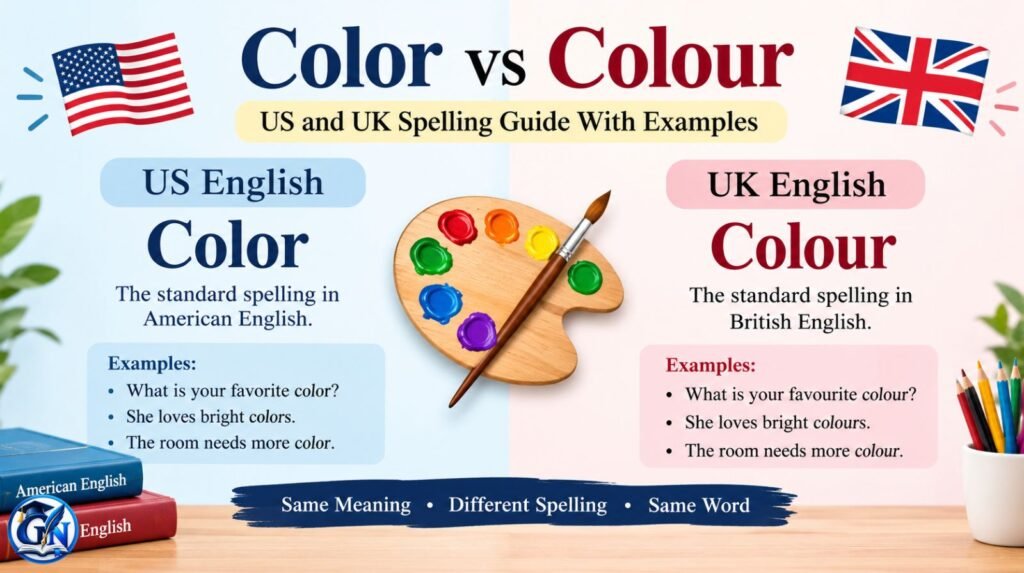
If you have ever wondered whether color vs colour is the correct spelling, you are not alone. Both forms are correct, but they belong to different varieties of English. Color is the standard spelling in American English, while colour is the standard spelling in British English and several other varieties of English.
The difference is simple once you know the rule. However, choosing the right spelling can matter when you are writing for a particular country, school, company, website, or audience.
In this guide, you will learn the difference between color and colour, where each spelling is used, how the words work in sentences, and how to keep your writing consistent.
Color vs Colour: What Is the Difference?
The main difference between color and colour is regional spelling.
Color is the American English spelling. Colour is the British English spelling. They have the same meaning, pronunciation, and grammatical function. Cambridge Dictionary specifically identifies color as the US spelling of colour and colour as the UK spelling of color.
Color Is the US Spelling
In American English, write color without the letter u.
Examples:
- What is your favorite color?
- Blue is my favorite color.
- The artist used bright colors.
- I love the color of your new car.
- The room needs more color.
American English also uses related forms such as colored, coloring, and colorful.
For example:
She bought a colorful dress for the party.
Colour Is the UK Spelling
In British English, write colour with a u.
Examples:
- What is your favourite colour?
- Blue is my favourite colour.
- The artist used bright colours.
- I love the colour of your new car.
- The room needs more colour.
British English also commonly uses coloured, colouring, and colourful.
For example:
She bought a colourful dress for the party.
The difference is therefore not about meaning. It is primarily a difference in regional spelling conventions.
Is Color or Colour Correct?
Both color and colour are correct spellings.
The correct choice depends on the variety of English you are using.
When to Use Color
Use color when writing in American English.
For example:
- The website uses a bright color scheme.
- What color is the new logo?
- She prefers warm colors.
- The photograph looks better in color.
If your audience is primarily in the United States, color is normally the better choice.
When to Use Colour
Use colour when writing in British English.
For example:
- What colour is your new car?
- The website uses a bright colour scheme.
- She prefers warm colours.
- The photograph looks better in colour.
If your content follows British English conventions, use colour consistently.
Neither Spelling Is a Mistake
Seeing colour in an American context or color in a British context does not automatically mean the writer made a spelling mistake.
They are established spelling variants.
The MLA Style Center, for example, notes that a spelling following a different standard system is not necessarily an error and does not need to be marked with “sic.”
That is an important point for students, editors, and international writers: regional spelling differences are not the same thing as spelling errors.
Color vs Colour in American and British English
The easiest way to remember the difference is to associate the spelling with the English variety.
| Word | American English | British English |
|---|---|---|
| Color / Colour | color | colour |
| Colors / Colours | colors | colours |
| Colored / Coloured | colored | coloured |
| Coloring / Colouring | coloring | colouring |
| Colorful / Colourful | colorful | colourful |
| Multicolored / Multicoloured | multicolored | multicoloured |
A Simple Memory Trick
Think of the U in colour as being associated with the UK.
UK → colour
US → color
This is not a linguistic rule for every British-American spelling difference, but it is a useful memory trick for this particular word.
Examples Side by Side
Here are some direct comparisons:
American English:
My favorite color is green.
British English:
My favourite colour is green.
Another example:
American English:
The walls were painted in bright colors.
British English:
The walls were painted in bright colours.
Notice that other words can change as well. In these examples, favorite/favourite follows the same US/UK spelling distinction.
Color vs Colour: Why Does the Spelling Change?
The difference comes from the historical development of American and British English spelling conventions.
American English Simplified Some Spellings
American English developed a number of spelling preferences that differ from British English. One familiar pattern is the omission of u in words such as:
- color → colour
- honor → honour
- favor → favour
- labor → labour
American English generally uses the shorter forms:
- color
- honor
- favor
- labor
British English generally retains the u:
- colour
- honour
- favour
- labour
The Pattern Appears in Related Words
The spelling difference does not stop with the noun color/colour.
For example:
US English:
- color
- colored
- coloring
UK English:
- colour
- coloured
- colouring
Cambridge Dictionary likewise lists coloring as the US spelling of colouring and coloured as the UK spelling of colored.
Therefore, if you choose one English variety, it is best to carry that spelling consistently through related words.
How to Choose Between Color and Colour
If you are unsure which spelling to use, consider who will read your writing and which style guide you are following.
For US Readers, Choose Color
Use color for content intended primarily for an American audience.
Examples include:
- US school assignments
- American business websites
- US-focused blogs
- American marketing materials
- Content written in American English
For example:
The designer selected a neutral color palette for the website.
For UK Readers, Choose Colour
Use colour for content written in British English.
Examples include:
- UK school assignments
- British publications
- UK-focused websites
- British business communications
- Content following British English conventions
For example:
The designer selected a neutral colour palette for the website.
For International Websites, Be Consistent
International websites have a slightly different challenge.
If your website serves readers from both the US and UK, you do not necessarily need to use both spellings randomly. Instead, choose one primary English variety and use it consistently.
For example, if your website follows American English, use:
color, favorite, organize, center
If it follows British English, use:
colour, favourite, organise, centre
Consistency makes your content look more professional and easier to edit.
A Real-Life Example: Choosing a Style for a Global Website
Imagine a company called BrightHome sells interior-design products online. Its marketing team creates a page about choosing paint for bedrooms.
The US version of the page says:
“Choose a calming color such as soft blue or warm beige. Our designers recommend neutral colors for smaller bedrooms.”
The company’s UK editor reviews the page and changes it to:
“Choose a calming colour such as soft blue or warm beige. Our designers recommend neutral colours for smaller bedrooms.”
Neither editor has corrected a genuine spelling mistake. They have simply adapted the content to their preferred variety of English.
Now imagine that the company publishes hundreds of pages. If some pages use color, others use colour, and still others switch between favorite/favourite and center/centre, the website can begin to look inconsistent.
The solution is not to decide that one form is universally “correct.” Instead, the company should establish a style guide. If its primary market is the United States, it might select American English. If its main market is the United Kingdom, it might select British English. If it operates globally, it can select one primary editorial style and make deliberate exceptions when content is specifically localized.
This approach is useful beyond websites. Students, publishers, journalists, translators, and businesses regularly make similar decisions. The important lesson is that audience and consistency should guide the choice.
Color vs Colour: 2026 Data and Usage Context
There is an important limitation when discussing “statistics” about color vs colour: there is no authoritative public statistic that says exactly what percentage of all English speakers use one spelling or the other.
Google Trends can show relative search interest, but it does not provide a simple worldwide count of how many people use a particular spelling. Google explains that Trends data is sampled, aggregated, normalized, and scaled from 0 to 100, so it should be interpreted as relative search interest rather than absolute search volume.
As of 2026, Google Trends also allows users to compare search terms and examine search behavior by geography, which can be useful when researching regional language preferences.
Another useful current reference is the Associated Press Stylebook. AP’s current print edition is the 58th Edition, published in 2026, and AP says its digital Stylebook is updated throughout the year. AP also identifies Merriam-Webster as its primary dictionary reference for spelling, style, and usage.
So, rather than inventing a percentage for color-versus-colour usage, the more reliable conclusion is:
The spelling is strongly associated with regional English standards: “color” is US English, while “colour” is UK English.
Common Examples of Color and Colour
Understanding the word in real sentences makes the difference easier to remember.
Examples With Color
- What color is your car?
- Red is my favorite color.
- The artist mixed several colors.
- Please choose a color for the background.
- The children were coloring pictures.
- She wore a colorful jacket.
- The image looks better in color.
Examples With Colour
- What colour is your car?
- Red is my favourite colour.
- The artist mixed several colours.
- Please choose a colour for the background.
- The children were colouring pictures.
- She wore a colourful jacket.
- The image looks better in colour.
What About the Verb?
The same regional spelling applies when color/colour is used as a verb.
US English:
Please color the picture blue.
UK English:
Please colour the picture blue.
Cambridge lists the verb color as the US form and colour as the UK form.
Quick Checklist: Color or Colour?
Use this checklist whenever you are proofreading your writing.
Step 1: Identify Your Audience
Ask:
Am I mainly writing for US or UK readers?
If US → color
If UK → colour
Step 2: Check Your Style Guide
If your school, employer, publisher, or client specifies American or British English, follow that requirement.
Style guides exist specifically to keep spelling and other editorial decisions consistent. AP, for example, describes its Stylebook as a reference for spelling, language, punctuation, usage, and journalistic style.
Step 3: Check Related Words
Do not correct only one word.
If you use:
color
also check related forms such as:
colored, coloring, colorful
If you use:
colour
check:
coloured, colouring, colourful
Step 4: Stay Consistent
Once you select a variety of English, keep using it unless there is a specific reason to localize the content.
FAQs
Q1: Is color or colour correct?
A: Both are correct. Color is the standard American English spelling, while colour is the standard British English spelling.
Q2: Is color American or British?
A: Color is the American English spelling. British English generally uses colour.
Q3: Is colour British or American?
A: Colour is the British English spelling. American English generally uses color.
Q4: Do color and colour mean the same thing?
A: Yes. They have the same basic meaning. The difference is primarily a regional spelling convention.
Q5: Which spelling should I use in an American essay?
A: Use color if your essay follows American English. For example: “My favorite color is blue.”
Q6: Which spelling should I use in a British essay?
A: Use colour if your essay follows British English. For example: “My favourite colour is blue.”
Q7: Is “colours” wrong in American English?
A: In standard American English, colors is the usual spelling. Colours is the British spelling.
Q8: Is “color” wrong in British English?
A: Not necessarily. Color is the American spelling, but it may appear in British contexts when American English is being quoted, referenced, or intentionally used. The key is to follow the spelling standard appropriate to your context.
Conclusion:
The color vs colour difference is straightforward: color is the standard US spelling, while colour is the standard UK spelling. Both words have the same meaning, and neither is inherently more correct than the other.
If you are writing for an American audience, choose color. If you are writing in British English, choose colour. Most importantly, remain consistent throughout your article, essay, website, or document.
Once you remember US = color and UK = colour, this common spelling question becomes much easier.
👉 Discover more simple and practical grammar guides on Gramnora

Explore the world of English grammar with simple explanations, practical examples, and easy-to-follow guides by Zia Tarar, the founder and author of Gramnora. From essential grammar rules and sentence structure to common mistakes and advanced concepts, Gramnora helps learners improve their English, strengthen their writing skills, and communicate with greater clarity and confidence.