
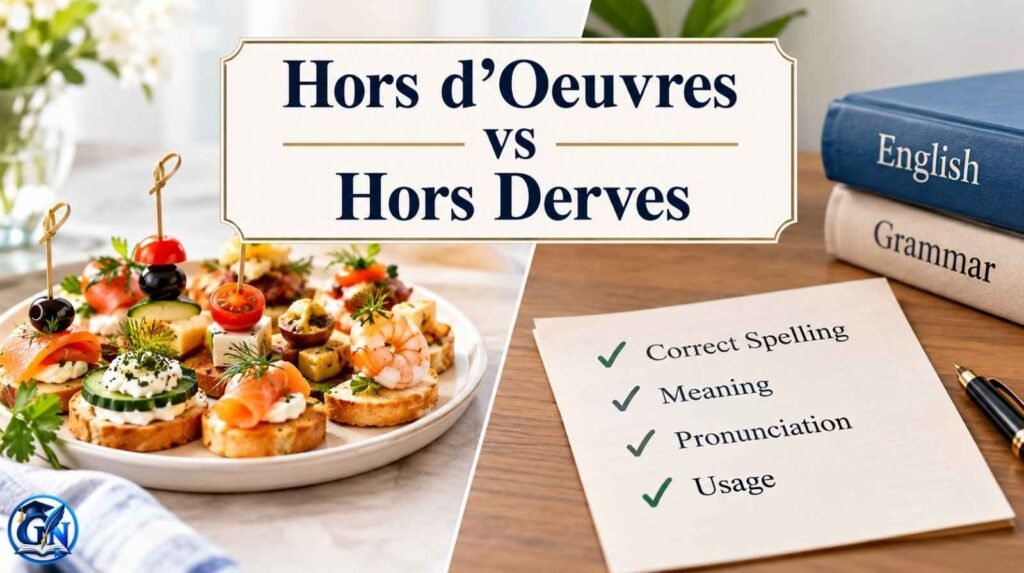
Have you ever tried o write Hors d’Oeuvres vs Hors Derves might actually be the correct spelling? You are not alone. This French-derived expression can be surprisingly difficult to spell because its pronunciation looks very different from its written form.
The good news is simple: hors d’oeuvres is the correct standard spelling, while hors derves is a misspelling.
The word refers to small portions of food served before a meal or at a gathering such as a party, reception, or cocktail event. Major English dictionaries recognize hors d’oeuvre as the singular form and hors d’oeuvres as the plural form.
In this guide, you will learn the difference between hors d’oeuvres vs hors derves, what the expression means, how to pronounce it, when to use the singular and plural forms, and a few simple tricks for remembering its unusual spelling.
Hors d’Oeuvres vs Hors Derves: Which Spelling Is Correct?
The correct spelling is hors d’oeuvres.
Hors derves is not a standard English spelling. It is generally a pronunciation-based misspelling caused by the fact that the spoken form of hors d’oeuvres does not closely resemble its written form.
Hors d’oeuvres Is Correct
Use hors d’oeuvres when referring to multiple small dishes or portions of food served before a meal or at a social gathering.
For example:
- The restaurant served delicious hors d’oeuvres before dinner.
- Guests enjoyed several hors d’oeuvres during the reception.
- The caterer prepared hot and cold hors d’oeuvres for the event.
Cambridge defines hors d’oeuvre as a small amount of food served before a meal or at a party, while Oxford gives the singular form as hors d’oeuvre and the plural as hors d’oeuvres.
Hors Derves Is Incorrect
Hors derves is not an alternative spelling with a different meaning.
For example:
Incorrect: The guests enjoyed several hors derves.
The corrected version is:
Correct: The guests enjoyed several hors d’oeuvres.
The mistake is understandable because the word is commonly pronounced approximately like “or-DERVZ” in American English. That pronunciation can make hors derves seem logical when someone is writing the word from sound alone.
Quick Comparison
| Spelling | Correct? | Use |
|---|---|---|
| hors d’oeuvre | Yes | Singular |
| hors d’oeuvres | Yes | Plural |
| hors derves | No | Misspelling |
| hors doeuvres | No | Missing apostrophe |
| hors deuvres | No | Missing the “o” |
So, if you are writing a menu, invitation, article, email, or school assignment, choose hors d’oeuvres, not hors derves.
What Does Hors d’Oeuvres Mean?
Hors d’oeuvres means small portions of food served before a meal or separately at a social gathering. Depending on the setting, they can be hot or cold and may be served at a table or passed around to guests.
Meaning and Origin
The expression comes from French. Its literal sense is related to something being outside the main work or main course. The culinary meaning developed around food served apart from the principal courses of a meal.
This French origin is one reason the spelling can look unfamiliar to English speakers.
For example, you might see hors d’oeuvres at:
- Wedding receptions
- Cocktail parties
- Business events
- Dinner parties
- Restaurant gatherings
- Holiday celebrations
Examples of Hors d’Oeuvres
Hors d’oeuvres can include many different types of small foods, such as:
- Mini sandwiches
- Stuffed mushrooms
- Cheese and crackers
- Bruschetta
- Shrimp
- Crostini
- Deviled eggs
- Small savory pastries
- Vegetable bites
- Smoked salmon pieces
For example:
The hotel served elegant hors d’oeuvres while guests waited for the wedding ceremony to begin.
The exact food does not determine whether something is called an hors d’oeuvre. The context and the way the food is served are important.
Hors d’Oeuvres vs Appetizers
The words hors d’oeuvres and appetizers can overlap in meaning, but they are not always used in exactly the same way.
An appetizer is generally a small dish served before a main course. Hors d’oeuvres often has a stronger association with receptions, parties, cocktail hours, and small foods served separately from the main meal.
Therefore, both words can be appropriate depending on the context.
Hors d’Oeuvre vs Hors d’Oeuvres: Singular and Plural
One of the most important things to remember is that hors d’oeuvre and hors d’oeuvres are different forms.
Hors d’Oeuvre Is Singular
Use hors d’oeuvre when you mean one item.
For example:
The chef prepared one elegant hors d’oeuvre.
Another example:
Each guest received an hors d’oeuvre before dinner.
Hors d’Oeuvres Is Plural
Use hors d’oeuvres when you mean more than one item.
For example:
The chef prepared several hors d’oeuvres.
Or:
We served a variety of hors d’oeuvres at the reception.
Oxford lists hors d’oeuvres as the plural form, while Cambridge notes that both hors d’oeuvre and hors d’oeuvres can occur as plural forms in English usage.
For everyday formal writing, however, hors d’oeuvre for one and hors d’oeuvres for multiple items is the easiest rule to follow.
A Simple Number Rule
Remember:
One → hors d’oeuvre
Two or more → hors d’oeuvres
Examples:
- One hors d’oeuvre
- Two hors d’oeuvres
- Several hors d’oeuvres
- A tray of hors d’oeuvres
This small distinction can prevent another common writing mistake.
Why Is Hors d’Oeuvres So Difficult to Spell?
The main problem is the difference between pronunciation and spelling.
The Pronunciation Does Not Reveal the Spelling
In American English, hors d’oeuvres is commonly pronounced approximately “or-DERVZ.”
If you hear the word without seeing it written, it is easy to imagine spellings such as:
- hors derves
- hors deuvres
- hors doeuvres
- horse d’oeuvres
However, none of these replaces the standard spelling hors d’oeuvres.
The “Oeuvres” Part Is the Tricky Part
The most difficult section is usually:
oeuvres
It does not look or sound like a typical English word.
Instead of trying to spell the entire expression from pronunciation, memorize its visual pattern:
hors d’oeuvres
Break it into:
hors + d’ + oeuvres
This makes the spelling much easier to recognize.
Easy Memory Trick
Think:
HORS — D’ — OEUVRES
Then remember:
- hors, not horse
- d’, not d
- oeuvres, not derves
The most important part is to keep oeuvres intact.
Common Misspellings of Hors d’Oeuvres
Because this expression is difficult to spell, several incorrect versions can appear in informal writing.
Hors Derves
This is the spelling in the comparison covered by this article.
Incorrect: hors derves
Correct: hors d’oeuvres
The mistake usually comes from pronunciation.
Hors Doeuvres
Some writers remember the letters but leave out the apostrophe.
Incorrect: hors doeuvres
Correct: hors d’oeuvres
The apostrophe is part of the conventional English spelling.
Hors Deuvres
Another common mistake is leaving out the o in oeuvres.
Incorrect: hors deuvres
Correct: hors d’oeuvres
Horse d’Oeuvres
This is sometimes seen as a humorous or accidental spelling.
Incorrect: horse d’oeuvres
Correct: hors d’oeuvres
The word is hors, not horse.
Spelling Checklist
| Common mistake | Correct form |
|---|---|
| hors derves | hors d’oeuvres |
| hors doeuvres | hors d’oeuvres |
| hors deuvres | hors d’oeuvres |
| horse d’oeuvres | hors d’oeuvres |
| hors d’oeuvre’s | hors d’oeuvres when simply making it plural |
If you are unsure, look at the full form rather than trying to reconstruct it from pronunciation.
A Real-Life Example: Writing an Event Invitation
Imagine that you are preparing an invitation for a wedding reception.
You want to tell guests that small foods will be available before dinner. You type:
Hors Derves will be served at 6:00 p.m.
At first glance, the sentence may look understandable. However, hors derves is not the standard spelling.
A polished version would be:
Hors d’oeuvres will be served at 6:00 p.m.
Now imagine that the invitation is being printed for hundreds of guests. A small spelling error becomes much more noticeable because invitations are expected to be carefully edited.
The same issue could occur in a restaurant menu. A chef might write:
Today’s Hors Derves
A customer familiar with the term would probably understand what was intended, but the standard spelling is:
Today’s Hors d’Oeuvres
This example illustrates why spelling from pronunciation can be risky. The word sounds much simpler than it looks. Rather than trying to guess the spelling each time, it is better to memorize the established form.
The same principle applies to professional emails, catering advertisements, restaurant websites, wedding invitations, event programs, and blog posts. If the audience sees hors d’oeuvres, the spelling immediately looks familiar and established. If they see hors derves, it can appear to be a simple typo.
Therefore, whenever you are describing several small foods served before or around a meal, check the number first and then use hors d’oeuvres.
2025–2026 Reference and Usage Snapshot
There is an important distinction between dictionary evidence and a statistical measure of how frequently a misspelling occurs. Publicly available dictionary sources establish the standard spelling, but they do not provide a reliable percentage showing how many people misspell hors d’oeuvres as hors derves.
A useful 2025–2026 reference snapshot is therefore to compare current major dictionary entries:
| Reference source | Current information | What it confirms |
|---|---|---|
| Cambridge Dictionary | Current entry | hors d’oeuvre is an established noun and lists plural forms |
| Oxford Learner’s Dictionaries | Current entry | hors d’oeuvre with plural hors d’oeuvres |
| Collins Dictionary | Current entry; American entry cites the 2025 Webster’s New World College Dictionary | Meaning, spelling, pronunciation, and plural usage |
Cambridge currently lists hors d’oeuvre and gives both hors d’oeuvre and hors d’oeuvres as plural possibilities. Oxford lists hors d’oeuvre with hors d’oeuvres as the plural. Collins likewise gives hors d’oeuvres as a plural form and explains its French origin.
This gives us a useful current evidence base: three major dictionary references agree that “hors d’oeuvre/hors d’oeuvres” is the established English form, while “hors derves” is not presented as a standard alternative.
Because dictionary entries are not population surveys, it would be misleading to turn this into a percentage or claim that a specific percentage of writers use one spelling. The safest conclusion from the current reference data is the spelling itself: use hors d’oeuvre for one and hors d’oeuvres for multiple items.
How to Remember the Correct Spelling
You do not need to memorize a complicated grammar rule. A simple visual method works well.
Remember the Three Parts
Think of the plural as:
HORS + D’ + OEUVRES
Then check three things:
- Did I write hors?
- Did I include d’?
- Did I spell oeuvres correctly?
If all three are correct, you have hors d’oeuvres.
Do Not Spell It by Sound
The pronunciation can tempt you to write:
hors derves
Instead, think of the written form first:
hors d’oeuvres
This is especially useful when writing an invitation, menu, essay, or professional document.
Use the Singular Form as a Guide
If you remember the singular form, the plural becomes easier:
Singular: hors d’oeuvre
Plural: hors d’oeuvres
The plural simply adds s to the end.
Hors d’Oeuvres vs Hors Derves: Quick Comparison
| Feature | Hors d’oeuvres | Hors derves |
|---|---|---|
| Standard spelling | Yes | No |
| Meaning | Small food portions served before or around a meal | No standard meaning |
| Language origin | French | Misspelling |
| Suitable for formal writing | Yes | No |
| Singular form | hors d’oeuvre | — |
| Plural form | hors d’oeuvres | — |
| Pronunciation-based spelling | No | Yes |
The difference is therefore straightforward: hors d’oeuvres is the established spelling; hors derves is a misspelling.
FAQs
Q1: Is “hors derves” a correct spelling?
A: No. Hors derves is a misspelling. The standard spelling is hors d’oeuvres.
Q2: How do you spell hors d’oeuvres correctly?
A: Spell it:
H-O-R-S D-’O-E-U-V-R-E-S
The complete form is hors d’oeuvres.
Q3: What is the singular of hors d’oeuvres?
A: The singular form is hors d’oeuvre.
For example:
The chef prepared one hors d’oeuvre.
The plural is:
The chef prepared several hors d’oeuvres.
Q4: What does hors d’oeuvres mean?
A: Hors d’oeuvres are small portions of food served before a meal or at gatherings such as receptions and parties. Cambridge describes the term as small food served before a meal or at a party.
Q5: How do you pronounce hors d’oeuvres?
A: In American English, it is commonly pronounced approximately “or-DERVZ.” Pronunciation can vary by accent and language background.
Q6: Is “hors d’oeuvre” singular or plural?
A: Hors d’oeuvre is the standard singular form, while hors d’oeuvres is the standard plural form in common English usage. Some dictionaries also recognize hors d’oeuvre as a plural variant.
Q7: Are hors d’oeuvres and appetizers the same?
A: They can overlap in meaning, but the terms are not always interchangeable in every context. Appetizer is a broad term for food served before a meal, while hors d’oeuvres often refers to small foods served at parties, receptions, cocktail events, or separately from the main meal.
Q8: Can I use hors d’oeuvres in a formal invitation?
A: Yes. Hors d’oeuvres is appropriate for formal invitations, restaurant menus, business events, wedding receptions, and other polished forms of writing.
Conclusion
When comparing hors d’oeuvres vs hors derves, the answer is clear: hors d’oeuvres is the correct standard spelling, while hors derves is a misspelling.
Remember the two main forms:
- One: hors d’oeuvre
- More than one: hors d’oeuvres
The unusual spelling comes from the expression’s French origin and its pronunciation in English. Because the spoken form does not clearly reveal the written form, it is easy to create a spelling such as hors derves. However, the safest approach is to memorize the visual pattern hors d’oeuvres rather than spelling the word from sound.
Major dictionary references, including Cambridge, Oxford, and Collins, support the established spelling and meaning.
👉 Discover more simple and practical grammar guides on Gramnora

Explore the world of English grammar with simple explanations, practical examples, and easy-to-follow guides by Zia Tarar, the founder and author of Gramnora. From essential grammar rules and sentence structure to common mistakes and advanced concepts, Gramnora helps learners improve their English, strengthen their writing skills, and communicate with greater clarity and confidence.