
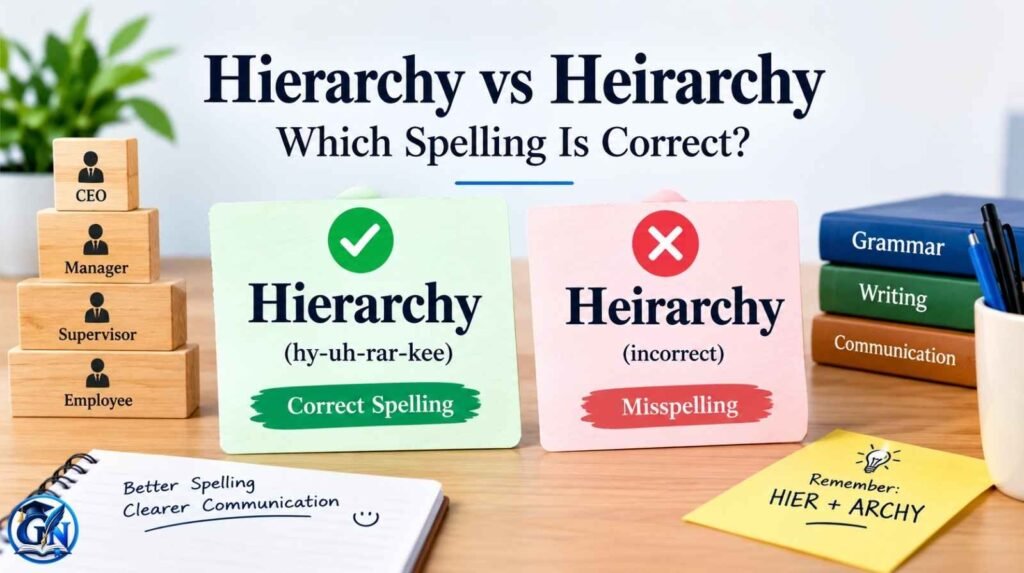
Have you ever typed “heirarchy” and wondered whether it looks right? If so, you are not alone. Hierarchy and heirarchy can be confusing because the word contains a sequence of letters that is easy to rearrange.
The correct spelling is hierarchy. Heirarchy is a misspelling and should not be used in standard English. In this guide, you will learn the meaning of hierarchy, why “heirarchy” is incorrect, how to pronounce the word, useful examples, and a simple trick to remember the correct spelling.
Hierarchy vs Heirarchy: The Quick Answer
The correct word is hierarchy:
H-I-E-R-A-R-C-H-Y
The spelling heirarchy is incorrect.
Hierarchy is a noun referring to a system in which people or things are arranged according to levels of importance, authority, rank, or status. Cambridge Dictionary defines it as a system in which people or things are arranged according to their importance.
| Spelling | Correct? | Meaning |
|---|---|---|
| Hierarchy | ✅ Yes | A system arranged in levels or ranks |
| Heirarchy | ❌ No | Common misspelling of “hierarchy” |
Example:
- The company has a clear hierarchy of management.
- The company has a clear heirarchy of management. ❌
So, if you are wondering “hierarchy vs heirarchy which one is correct?”, choose hierarchy every time.
What Does Hierarchy Mean?
A hierarchy is an arrangement in which people, organizations, ideas, or things are placed into different levels based on importance, authority, rank, or another organizing principle.
For example, a company may have a hierarchy in which a chief executive is at the top, followed by senior managers, department managers, supervisors, and other employees.
Cambridge Dictionary also gives examples involving social and political hierarchies, showing that the word can describe many different kinds of ranked systems.
Examples of hierarchy
Here are several simple examples:
- The school has a clear hierarchy of administration.
- The manager explained the company’s hierarchy to the new employee.
- Scientists often classify organisms using different levels of organization.
- The animals established a social hierarchy within the group.
- Understanding the website’s information hierarchy can make navigation easier.
The word is not limited to workplaces. You can use hierarchy when discussing organizations, social groups, information, systems, rankings, and many other structured arrangements.
What does hierarchical mean?
The adjective hierarchical describes something organized according to levels of importance, authority, or status.
For example:
The organization has a hierarchical structure.
Cambridge Dictionary defines hierarchical as being arranged according to people’s or things’ level of importance or relating to such a system.
Why Is “Heirarchy” Incorrect?
The most common mistake is inserting an extra “i” after “he.”
The correct form is:
hierarchy
The incorrect form is:
heirarchy
A useful way to understand the mistake is to look at the word in smaller parts:
hier + archy
The spelling begins with hier-, not heir-.
The sequence can be confusing because heir is itself a legitimate English word. An heir is someone who has a right to inherit property, money, or a title. Because “heir” is familiar, some writers accidentally put it into hierarchy.
However, the two words are unrelated in spelling.
Hierarchy vs heirarchy: don’t confuse “heir” with “hier”
Compare these:
- heir → a person who inherits
- hierarchy → a system of levels or ranks
For example:
The heir inherited the estate.
But:
The company has a strict hierarchy.
The similar-looking beginning is one reason heirarchy can feel natural even though it is not the standard spelling.
How to Spell Hierarchy Correctly
If you frequently misspell hierarchy, try remembering it as:
HIER + ARCHY
Then put the parts together:
HIER + ARCHY = HIERARCHY
The complete spelling is:
H-I-E-R-A-R-C-H-Y
One important point is that the word contains “hier”, not “heir.”
A simple memory trick for hierarchy
Try this:
A hierarchy has “hier” before “archy.”
Or remember:
HIER comes before ARCHY.
This small spelling pattern can help prevent the common heirarchy mistake.
Check the word before publishing
If you are writing an essay, article, report, resume, presentation, or professional email, take a moment to check the spelling.
For example:
❌ The organizational heirarchy is clearly defined.
✅ The organizational hierarchy is clearly defined.
Correct spelling is especially useful when you are writing for an audience because small errors can distract readers from your main message.
Hierarchy Pronunciation and Word Forms
Hierarchy is commonly pronounced approximately as:
HY-uh-rar-kee
or, depending on accent, HY-uh-rah-kee
Cambridge lists UK and US pronunciations that reflect these differences.
Because pronunciation varies somewhat between British and American English, listening to a trusted dictionary pronunciation can be helpful when learning the word.
Related forms of hierarchy
Here are some useful related words:
- hierarchy noun
- hierarchical adjective
- hierarchically adverb
- hierarchies plural noun
Examples:
The company has a clear hierarchy.
The company uses a hierarchical management structure.
The departments are organized hierarchically.
Several different hierarchies exist within the organization.
Cambridge also recognizes hierarchically as meaning that people or things are arranged according to levels of importance.
Hierarchy Examples in Everyday English
The word is especially common when discussing organizations and management.
The company has a traditional hierarchy.
She moved higher in the corporate hierarchy.
The manager explained the organizational hierarchy to the new employees.
Social examples
Hierarchy can also describe relationships within groups.
The animals developed a social hierarchy.
Social hierarchies can influence how groups interact.
Information and design examples
The word is also widely used when discussing information.
Good website design creates a clear information hierarchy.
Headings help readers understand the hierarchy of information on a page.
Academic examples
Students may encounter the word in subjects such as biology, sociology, psychology, business, and computer science.
The textbook explains the hierarchy of biological organization.
The researcher examined the social hierarchy within the group.
The broad range of uses is one reason learning the correct spelling is worthwhile.
A Real-World Case Study: Why Clear Terminology Matters
A useful real-world example comes from Grammarly’s 2025 case study of Zoom. Grammarly reported that Zoom’s marketing team was dealing with the challenge of maintaining consistent brand voice, terminology, and messaging as its global team expanded. The company needed new team members to follow established communication standards, while its content team was spending additional time checking writing manually.
According to Grammarly’s published case study, 71% of communications improved, more than 7,000 hours were saved on written communication, and more than 10,000 style-guide suggestions were delivered.
This example is not specifically about the spelling of hierarchy. Instead, it demonstrates a broader point that applies to spelling and word choice: consistent written language matters when information is shared across teams and audiences.
Imagine a company repeatedly writing “heirarchy” in reports, internal documents, or website copy. Even if readers understand the intended meaning, the error can undermine the professional appearance of the document. Using the correct hierarchy consistently helps keep written communication accurate and polished.
For individual writers, the lesson is simple: when a word looks unusual or contains a confusing letter sequence, checking it before publication is a small step that can prevent an avoidable error.
What Recent Communication Data Says About Careful Writing
The importance of accurate written communication is not limited to spelling exercises. Grammarly’s 2025 Productivity Shift report examined workplace communication and productivity, highlighting how much modern work depends on written communication.
Grammarly also reported in its 2025 research that only 13% of the workforce was considered AI fluent, while those workers reported saving more than 80% more time than their colleagues.
These figures are about workplace productivity rather than the spelling of individual words, so they should not be interpreted as evidence that spelling mistakes are increasing or decreasing. However, they reinforce the broader reality that written communication remains an important part of modern professional work.
For writers, students, and professionals, checking words such as hierarchy before submitting or publishing content is a simple part of maintaining clear communication.
Google likewise advises publishers to focus on helpful, reliable, people-first content and asks creators whether readers will leave a page having learned enough to accomplish their goal.
Hierarchy vs Heirarchy: A Simple Step-by-Step Check
When you are unsure whether to write hierarchy or heirarchy, follow these steps:
Step 1: Identify the meaning.
If you mean a system of levels, ranks, importance, or authority, you probably need hierarchy.
Step 2: Remember “hier.”
The word starts with hier, not heir.
Step 3: Check the full spelling.
Write:
H-I-E-R-A-R-C-H-Y
Step 4: Review the sentence.
Make sure the word fits the intended meaning.
Quick checklist
- Need a word meaning a system of levels? → hierarchy
- Need the adjective? → hierarchical
- Need the plural? → hierarchies
- Writing heirarchy? → Correct it to hierarchy
Common Mistakes With Hierarchy
Mistake 1: Writing “heirarchy”
❌ The company has a strict heirarchy.
✅ The company has a strict hierarchy.
Mistake 2: Confusing “heir” with “hier”
An heir is a person who inherits something.
A hierarchy is a system of levels or ranks.
They have different meanings and should not be treated as spelling variations.
Mistake 3: Using “hierarchy” when you mean “heir”
These words are not interchangeable.
❌ He is the hierarchy to the family estate.
✅ He is the heir to the family estate.
The first sentence uses the wrong word entirely.
FAQs
Q1: Is “heirarchy” a correct spelling?
A: No. Heirarchy is a misspelling. The correct spelling is hierarchy.
Q2: Which is correct: hierarchy or heirarchy?
A: Hierarchy is correct. Heirarchy is an incorrect spelling.
Q3: What does hierarchy mean?
A: A hierarchy is a system in which people or things are arranged into levels according to importance, rank, authority, or another organizing principle.
Q4: How do you spell hierarchy?
A: Spell it:
H-I-E-R-A-R-C-H-Y
A useful memory aid is HIER + ARCHY.
Q5: Why do people spell hierarchy as heirarchy?
A: The mistake likely comes from the familiar English word heir, which can make heirarchy look natural at first glance. However, the correct spelling begins with hier-.
Q6: What is the adjective form of hierarchy?
A: The adjective is hierarchical.
Example:
The company has a hierarchical structure.
Cambridge defines hierarchical as relating to or arranged according to levels of importance.
Q7: What is the plural of hierarchy?
A: The plural is hierarchies.
Example:
Different organizations can have different hierarchies.
Q8: How do you remember the spelling of hierarchy?
A: Remember:
HIER + ARCHY = HIERARCHY
The key is to use hier, not heir.
Conclusion:
When comparing hierarchy vs heirarchy, there is a clear answer: hierarchy is the correct spelling.
Heirarchy is a common misspelling, usually caused by confusion between hier- and the familiar word heir. If you remember HIER + ARCHY, the correct spelling becomes much easier to recall.
A hierarchy describes a system of levels, ranks, importance, or authority, and you can use it in contexts ranging from business and education to social groups and information design.
So, the next time you hesitate between hierarchy and heirarchy, choose hierarchy.
👉 Discover more simple and practical grammar guides on Gramnora

Explore the world of English grammar with simple explanations, practical examples, and easy-to-follow guides by Zia Tarar, the founder and author of Gramnora. From essential grammar rules and sentence structure to common mistakes and advanced concepts, Gramnora helps learners improve their English, strengthen their writing skills, and communicate with greater clarity and confidence.