
Have you ever typed congratulate and wondered whether it should actually be spelled congradulate? You’re not alone. These two spellings look very similar, and the way the word sounds can make the spelling especially confusing.
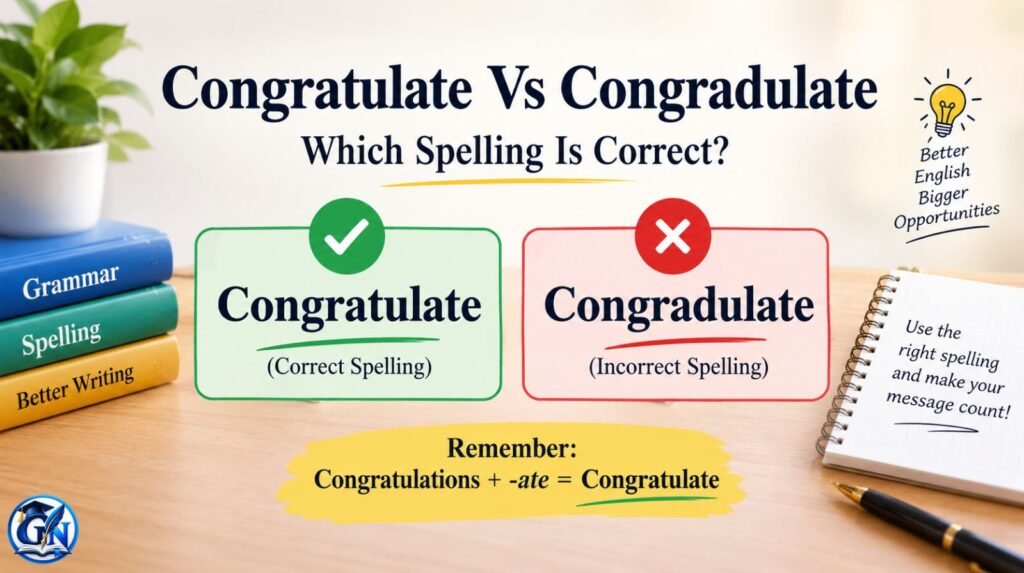
The correct spelling is congratulate. Congradulate is a common misspelling and is not the standard English spelling. The word congratulate is a verb meaning to praise someone or express pleasure about their success or achievement. Cambridge Dictionary gives examples such as congratulating someone on passing an exam or winning a race.
In this guide, you’ll learn the difference between congratulate vs congradulate, understand why the mistake happens, see practical examples, and learn a simple way to remember the correct spelling.
Congratulate vs Congradulate: The Quick Answer
Congratulate is the standard English spelling.
It is a verb used when you tell someone that you are pleased about their success, achievement, or good news.
Examples:
- I want to congratulate you on your promotion.
- We should congratulate Sarah on winning the competition.
- Please congratulate him on his graduation.
- They called to congratulate us on our new baby.
Cambridge Dictionary defines congratulate as expressing approval or pleasure about a special or unusual achievement.
Congradulate Is a Misspelling
Congradulate is not the standard spelling of the verb.
The confusion usually happens because the word’s pronunciation can make the middle sound seem closer to a d sound in some accents. However, the written form is congratulate, with t, not d.
| Spelling | Status | Example |
|---|---|---|
| Congratulate | Correct | I want to congratulate you. |
| Congradulate | Misspelling | I want to congradulate you. |
Easy rule: Remember congratulate = congratulations + -ate.
What Does Congratulate Mean?
Congratulate means to express happiness, approval, or praise when someone has achieved something or received good news.
For example:
I congratulated Maria on getting the new job.
Here, the speaker is expressing pleasure about Maria’s success.
The word is commonly used with on:
congratulate + someone + on + achievement
For example:
- I congratulated him on his success.
- She congratulated me on passing the exam.
- They congratulated us on our anniversary.
Cambridge’s examples similarly use congratulate with achievements such as passing a driving test and winning a race.
Congratulate as a Verb
Congratulate is a verb, so it describes an action.
Correct:
- I congratulated James.
- She congratulates her students.
- We will congratulate the winners.
- They are congratulating their friend.
The related forms include congratulated and congratulating. Cambridge identifies congratulated as the past simple and past participle of congratulate.
Congratulate vs Congratulations
These words are related but serve different grammatical purposes.
Congratulate is generally a verb:
I want to congratulate you.
Congratulations is commonly used as an expression of praise or good wishes:
Congratulations on your graduation!
Cambridge Dictionary lists congratulations as an expression used when you want to congratulate someone.
Why Do People Spell Congratulate as Congradulate?
One reason people write congradulate is pronunciation.
When spoken naturally, the middle consonant sounds in congratulate can be difficult to distinguish, particularly for English learners or speakers of different English varieties.
The standard spelling, however, remains:
con-g-r-a-t-u-l-a-t-e
Not:
con-g-r-a-d-u-l-a-t-e
The Word Is Related to Congratulations
Another useful clue is the related word congratulations.
Compare:
- congratulate
- congratulated
- congratulating
- congratulations
All retain the grat spelling.
Therefore, if you’re unsure whether the middle should contain t or d, think of congratulations.
An Easy Memory Trick
Use this simple sentence:
I congratulate you on your congratulations-worthy achievement.
The key spelling pattern is:
GRAT
So remember:
CON + GRAT + ULATE = CONGRATULATE
That makes it easier to avoid writing congradulate.
Congratulate Vs Congradulate: Examples You Can Use
Here are several natural examples:
- I would like to congratulate you on your achievement.
- Please congratulate Sarah on her promotion.
- We should congratulate the team for their excellent performance.
- Everyone came to congratulate him on his graduation.
- I called my friend to congratulate her.
- The teacher congratulated the students on their results.
- They are congratulating their colleague on the award.
Incorrect Sentences With Congradulate
These sentences contain the common spelling error:
- I want to congradulate you.
- She congradulated him on his success.
- We should congradulate the winners.
Replace congradulate with congratulate:
- I want to congratulate you.
- She congratulated him on his success.
- We should congratulate the winners.
Common Word Forms
| Word form | Correct spelling | Example |
|---|---|---|
| Base verb | congratulate | I congratulate you. |
| Third-person singular | congratulates | She congratulates him. |
| Past tense | congratulated | They congratulated me. |
| Present participle | congratulating | We are congratulating her. |
| Related noun/expression | congratulations | Congratulations on your success! |
These forms preserve the same congrat- spelling pattern. Cambridge’s dictionary entries document congratulate, congratulated, and congratulating as related forms.
A Real-Life Example: Congratulating Someone on a Promotion
Imagine that your coworker, Daniel, has just been promoted to manager after several years of hard work. You want to send him a short message.
You might write:
Congratulations on your promotion, Daniel! I want to congratulate you on this well-deserved achievement. Your hard work and dedication have clearly paid off. I hope you enjoy your new role and have continued success.
Now imagine that you type congradulate instead:
I want to congradulate you on this achievement.
The meaning may still be understandable to the reader, but the spelling is incorrect. In a professional email, workplace announcement, school assignment, or formal message, using the standard spelling is important because spelling errors can distract from an otherwise polished message.
This example also shows why understanding the difference between congratulate and congratulations matters. You could begin with “Congratulations!”, then use the verb “congratulate” later in the message.
For example:
Congratulations on your promotion! I would like to congratulate you on reaching this important career milestone.
Both words are correct, but they perform different grammatical jobs.
2025–2026 Evidence Snapshot
As of September 2026, current online dictionary entries support congratulate as the standard English verb. Cambridge Dictionary lists congratulate as a B2 verb and defines it in connection with praising someone or expressing pleasure about an achievement.
Cambridge also provides current entries for related forms including congratulated and congratulating, reinforcing the standard spelling pattern.
Why There Is No Reliable “2025–2026 Misspelling Percentage”
There is no dependable public statistic that establishes exactly what percentage of English writers typed congradulate instead of congratulate during 2025–2026.
Rather than inventing a search-volume or error-rate statistic, the useful evidence is the current dictionary record: authoritative English-language references list congratulate, while the spelling congradulate is not the standard dictionary form.
For a spelling article, this distinction matters. A search query, autocomplete suggestion, or user-generated webpage can show that a misspelling exists online, but its presence does not make that spelling correct.
A Simple Step-by-Step Way to Remember the Correct Spelling
Step 1: Think of “Congratulations”
Start with the familiar expression:
Congratulations!
Step 2: Notice the “grat” Pattern
Look at the middle:
con + grat + ulations
The verb keeps the same important grat sequence:
con + grat + ulate
Step 3: Write Congratulate
The correct spelling is:
C-O-N-G-R-A-T-U-L-A-T-E
Step 4: Check Before You Send
If you have written congradulate, stop and replace the d with t.
Wrong: congradulate
Correct: congratulate
This four-step check is especially useful when writing emails, school assignments, social media posts, greeting cards, or professional messages.
FAQs
Q1: Is Congratulate or Congradulate Correct?
A: Congratulate is the correct spelling. Congradulate is a common misspelling.
Q2: Is Congradulate a Word?
A: Congradulate is not the standard English spelling of the verb. The standard form is congratulate.
Q3: How Do You Spell Congratulate?
A: The correct spelling is:
C-O-N-G-R-A-T-U-L-A-T-E
A helpful way to remember it is con + grat + ulate.
Q4: What Does Congratulate Mean?
A: Congratulate means to express pleasure, approval, or praise because someone has achieved something or received good news.
Q5: What Is the Past Tense of Congratulate?
A: The past tense is congratulated.
Example:
We congratulated her on winning the award.
Cambridge identifies congratulated as the past simple and past participle of congratulate.
Q6: What Is the Difference Between Congratulate and Congratulations?
A: Congratulate is a verb:
I want to congratulate you.
Congratulations is commonly used as an expression of good wishes or praise:
Congratulations on your new job!
Cambridge lists congratulations as an expression used when you want to congratulate someone.
Q7: What Preposition Is Used With Congratulate?
A: The most common construction is congratulate someone on something.
Examples:
- I congratulated her on her promotion.
- He congratulated me on passing the test.
- We congratulated them on their success.
Q8: How Can I Remember the Spelling of Congratulate?
A: Think of the word congratulations and focus on grat.
CON + GRAT + ULATE = CONGRATULATE
Remembering the t in grat can help prevent the common congradulate mistake.
Conclusion:
When comparing congratulate vs congradulate, the answer is straightforward: congratulate is the correct spelling.
Use congratulate when you want to express praise or pleasure about someone’s achievement, success, or good news. The spelling congradulate is a common error, often caused by pronunciation.
The easiest way to remember the correct form is to connect it with congratulations and remember the grat spelling:
CON + GRAT + ULATE = CONGRATULATE
So, next time you write a professional email, school assignment, greeting card, or social media message, choose congratulate.
👉 Discover more simple and practical grammar guides on Gramnora

Explore the world of English grammar with simple explanations, practical examples, and easy-to-follow guides by Zia Tarar, the founder and author of Gramnora. From essential grammar rules and sentence structure to common mistakes and advanced concepts, Gramnora helps learners improve their English, strengthen their writing skills, and communicate with greater clarity and confidence.