
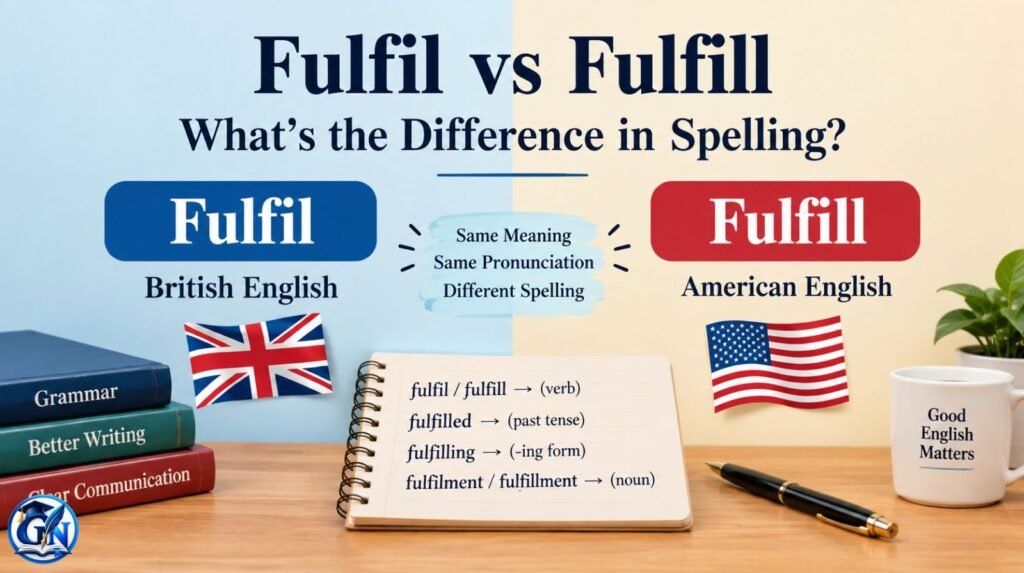
Have you ever wondered whether Fulfil vs Fulfill is the correct spelling? You are not alone. Both forms are widely used, and the difference can be confusing, especially when switching between British and American English.
The good news is that both “fulfil” and “fulfill” are correct spellings. The main difference is regional: fulfil is the standard spelling in British English, while fulfill is the standard spelling in American English. They have the same meaning, pronunciation, and grammatical function.
In this guide, you’ll learn the difference between fulfil vs fulfill, when to use each spelling, how their related forms are written, and how to avoid common mistakes.
Fulfil vs Fulfill: What Is the Difference?
The difference between fulfil and fulfill is primarily a matter of English spelling conventions rather than meaning.
Fulfil in British English
Fulfil is the usual British English spelling.
For example:
- She worked hard to fulfil her ambition.
- The company must fulfil all the requirements.
- We hope to fulfil our promise.
- The new policy should fulfil its intended purpose.
Cambridge Dictionary identifies fulfil as the mainly UK form and gives fulfill as the usual US spelling.
Fulfill in American English
Fulfill is the standard American English spelling.
For example:
- She worked hard to fulfill her ambition.
- The company must fulfill all the requirements.
- We hope to fulfill our promise.
- The new policy should fulfill its intended purpose.
Cambridge lists fulfill as the US spelling of fulfil.
Quick Comparison
| Feature | British English | American English |
|---|---|---|
| Verb | fulfil | fulfill |
| Meaning | Same | Same |
| Pronunciation | Same | Same |
| Past tense | fulfilled | fulfilled |
| -ing form | fulfilling | fulfilling |
| Noun | fulfilment | fulfillment |
Therefore, neither spelling is inherently wrong. The best choice depends on the variety of English you are using.
What Does Fulfil or Fulfill Mean?
Both fulfil and fulfill are verbs. They can be used when talking about completing something, meeting a requirement, satisfying an expectation, or achieving something hoped for.
To Complete a Requirement
One common meaning is to do something that is required or necessary.
For example:
You must fulfil all the course requirements before graduation.
In American English:
You must fulfill all the course requirements before graduation.
The meaning remains exactly the same.
To Achieve a Hope or Ambition
The word can also describe achieving something you hoped or planned to achieve.
Examples:
- She finally fulfilled her dream of becoming a writer.
- He hopes to fulfil his potential as an athlete.
- They worked for years to fulfill their ambition.
- The experience helped her fulfil a lifelong goal.
Oxford defines fulfil as doing or achieving what was hoped for or expected, as well as doing what is required or necessary.
To Meet a Promise, Duty, or Obligation
Both forms can also be used with words such as promise, duty, obligation, contract, and requirement.
For example:
- The company must fulfil its contractual obligations.
- The company must fulfill its contractual obligations.
- He promised to fulfil his duty.
- She worked hard to fulfill the terms of the agreement.
So, when you see fulfil vs fulfill, remember that the difference is spelling not meaning.
Fulfil vs Fulfill: Which Spelling Should You Use?
The easiest way to choose is to consider your audience and your chosen style of English.
Use Fulfil for British English
Use fulfil when writing according to British English conventions.
This is appropriate when your writing is primarily aimed at readers in places where British spelling is standard.
Examples:
- fulfil a requirement
- fulfil a promise
- fulfil an obligation
- fulfil an ambition
- fulfil a dream
Use Fulfill for American English
Use fulfill when following American English spelling.
Examples:
- fulfill a requirement
- fulfill a promise
- fulfill an obligation
- fulfill an ambition
- fulfill a dream
If you are writing for a US publication, school, company, or audience, fulfill is generally the appropriate choice.
Consistency Matters
The most important rule is consistency.
If an article uses British English, use fulfil throughout. If it follows American English, use fulfill throughout.
For example, avoid switching between:
The company will fulfil its obligations and fulfill customer requests.
A consistent British version would be:
The company will fulfil its obligations and fulfil customer requests.
A consistent American version would be:
The company will fulfill its obligations and fulfill customer requests.
This is particularly important in professional writing, academic work, websites, and business documents.
Fulfilment vs Fulfillment: The Same Spelling Difference
The spelling difference continues in the related noun.
British English: Fulfilment
British English generally uses fulfilment.
Examples:
- She found fulfilment in her work.
- The fulfilment of the agreement took several months.
- The company handles order fulfilment.
American English: Fulfillment
American English generally uses fulfillment.
Examples:
- She found fulfillment in her work.
- The fulfillment of the agreement took several months.
- The company handles order fulfillment.
Cambridge identifies fulfilment as mainly UK and fulfillment as the usual US form.
What About Fulfilled and Fulfilling?
Here is an important point that often causes confusion.
The past tense is:
fulfilled
And the -ing form is:
fulfilling
These spellings are used in both British and American English.
Examples:
- She fulfilled her promise.
- He is fulfilling his responsibilities.
- They have fulfilled all the requirements.
- It was a fulfilling experience.
Oxford lists the forms as fulfilled and fulfilling for both British and North American English.
Fulfil vs Fulfill: Comparison Table
Here is a quick reference you can save for future writing:
| Word/Form | British English | American English |
|---|---|---|
| Base verb | fulfil | fulfill |
| Past tense | fulfilled | fulfilled |
| -ing form | fulfilling | fulfilling |
| Noun | fulfilment | fulfillment |
| Meaning | Same | Same |
| Pronunciation | Same | Same |
A Simple Rule to Remember
Think of it this way:
UK → fulfil
US → fulfill
But when adding -ed or -ing, both varieties use:
fulfilled
fulfilling
That simple distinction will help you avoid most spelling mistakes.
Real-Life Example: Choosing the Right Spelling
Imagine that a British company is preparing an employee handbook. One section says:
“Every employee is expected to fulfil the responsibilities associated with their position.”
The spelling fulfil fits naturally because the company has chosen British English conventions.
Now imagine an American company writing a similar policy:
“Every employee is expected to fulfill the responsibilities associated with their position.”
The American company uses fulfill, which follows US spelling conventions.
Neither company has made a spelling mistake. They are simply following different regional standards.
The same situation occurs in education. A British student might write, “I hope to fulfil my academic potential,” while an American student might write, “I hope to fulfill my academic potential.” Both sentences communicate the same idea.
The difference can also appear in business. A British e-commerce company might refer to its order fulfilment process, while an American company may call the same process order fulfillment. Oxford specifically recognizes fulfil in the business sense of packing and sending an order to a customer.
This example shows why context matters. Instead of asking which spelling is universally correct, ask: Which variety of English am I using? Once that is clear, the choice becomes easy.
Common Mistakes With Fulfil and Fulfill
Although fulfil and fulfill are both correct, several incorrect forms are commonly confused with them.
Is Fullfil Correct?
No.
Fullfil is incorrect.
The correct forms are:
- fulfil — British English
- fulfill — American English
Do not add an extra l to the middle of the word.
Is Fulfiled Correct?
No.
The correct spelling is:
fulfilled
For example:
❌ She fulfiled her promise.
✅ She fulfilled her promise.
Is Fulfiling Correct?
No.
The correct spelling is:
fulfilling
For example:
❌ He is fulfiling his responsibilities.
✅ He is fulfilling his responsibilities.
This is one of those cases where the spelling may look surprising, but the standard form is the same in British and American English.
2025–2026 Reference and Usage Notes
Current dictionary references continue to recognize fulfil and fulfill as regional spellings rather than treating one as a misspelling of the other.
Cambridge’s current dictionary entries identify fulfil as mainly British and fulfill as mainly American. Oxford’s current learner dictionary likewise lists fulfil as British English and fulfill as North American English.
For an SEO and publishing perspective, Google’s current Search guidance also emphasizes helpful, reliable, people-first content and advises creators to use the language their readers actually use. Google’s Search Essentials page was updated in December 2025, while its 2025 guidance for Search and AI experiences continued to emphasize original, useful content rather than content created primarily to manipulate rankings.
Key 2025–2026 takeaways:
- 2 accepted regional spellings: fulfil and fulfill
- 1 shared meaning: to achieve, complete, satisfy, or carry out something
- 2 major spelling conventions: British and American English
- 2 shared inflected forms: fulfilled and fulfilling
These figures describe the spelling distinction itself, rather than search-volume statistics. There is no reliable current dictionary-based statistic showing that one form is universally “more correct” than the other.
FAQs
Q1: Is fulfil or fulfill correct?
A: Both are correct. Fulfil is the standard British English spelling, while fulfill is the standard American English spelling.
Q2: Is fulfil British or American English?
A: Fulfil is mainly the British English spelling. American English normally uses fulfill.
Q3: Is fulfill American English?
A: Yes. Fulfill is the standard American English spelling of the verb.
Q4: Do fulfil and fulfill have different meanings?
A: No. They have the same meaning and are pronounced the same. The main difference is the spelling convention associated with British or American English.
Q5: Is “fulfilled” spelled differently in British and American English?
A: No. Fulfilled is the standard spelling in both varieties.
Q6: Is “fulfilling” spelled with one or two Ls?
A: The correct spelling is fulfilling in both British and American English.
Q7: Which is correct: fulfilment or fulfillment?
A: Both are correct regional forms. Fulfilment is the British spelling, while fulfillment is the American spelling.
Q8: Is “fullfil” a correct spelling?
A: No. Fullfil is a misspelling. Use fulfil in British English or fulfill in American English.
Conclusion:
So, fulfil vs fulfill is not really a question of right versus wrong. Both spellings are correct; the difference comes from regional English conventions.
Use fulfil when following British English and fulfill when following American English. The related noun follows the same pattern: fulfilment in British English and fulfillment in American English. However, fulfilled and fulfilling are spelled the same in both varieties.
The easiest rule to remember is:
British English = fulfil
American English = fulfill
Choose the spelling that matches your audience, style guide, or variety of English and keep it consistent throughout your writing.
👉 Discover more simple and practical grammar guides on Gramnora

Explore the world of English grammar with simple explanations, practical examples, and easy-to-follow guides by Zia Tarar, the founder and author of Gramnora. From essential grammar rules and sentence structure to common mistakes and advanced concepts, Gramnora helps learners improve their English, strengthen their writing skills, and communicate with greater clarity and confidence.