
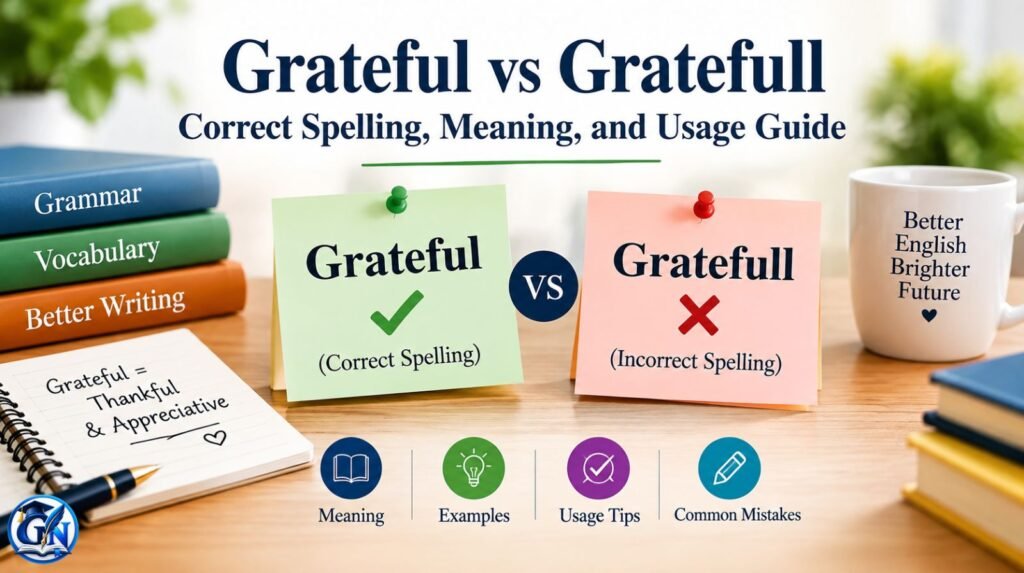
Have you ever typed “Grateful vs Gratefull” and wondered whether it should have one L or two? You are not alone. Grateful vs gratefull is a common spelling question because many English words ending in -ful can look confusing.
The correct spelling is grateful with only one L at the end. Gratefull is an incorrect spelling in standard English.
The word grateful is an adjective that means feeling or expressing thanks and appreciation. For example, you might say, “I am grateful for your help.”
In this guide, you will learn the difference between grateful and gratefull, what grateful means, how to use it correctly, common mistakes to avoid, and simple tricks for remembering the spelling.
Grateful vs Gratefull: Which Spelling Is Correct?
The correct spelling is grateful.
Grateful Is the Correct Spelling
Grateful is the standard English spelling:
I am grateful for your support.
It means that you feel thankful or appreciative because of someone’s kindness, help, or another positive experience. Cambridge Dictionary defines grateful as showing or expressing thanks, especially to another person.
Gratefull Is Incorrect
Gratefull is not the standard spelling of the adjective.
The mistake usually happens because people see the word full and assume that grateful should end with -full. However, that is not how the word is spelled.
| Spelling | Correct? | Example |
|---|---|---|
| grateful | ✅ Yes | I am grateful for your help. |
| gratefull | ❌ No | I am gratefull for your help. |
So, if you are writing an email, essay, social media post, application, or professional message, use grateful.
What Does Grateful Mean?
Grateful means feeling or expressing thanks because someone has helped you, supported you, or done something kind for you.
Grateful Meaning in Simple English
In simple terms:
Grateful = thankful or appreciative
For example:
I am grateful for your advice.
This means:
I appreciate your advice and feel thankful that you gave it to me.
The word can describe appreciation toward a person, an action, an opportunity, or a situation.
Grateful vs Thankful
Grateful and thankful are closely related and are often interchangeable.
For example:
- I am grateful for your help.
- I am thankful for your help.
However, Cambridge notes a useful distinction: grateful commonly describes appreciation when someone has been kind or helpful, while thankful can also describe relief that something unpleasant or dangerous did not happen.
For example:
I am grateful to my teacher for helping me.
But:
I am thankful that nobody was injured.
Both words are useful, but the context can influence which one sounds more natural.
How to Spell Grateful Correctly
Remembering the spelling is easier when you understand the structure of the word.
Grateful Has Only One L
The correct spelling is:
G-R-A-T-E-F-U-L
Notice that the ending is:
-ful
not:
-full
So:
✅ grateful
❌ gratefull
A helpful way to remember it is:
Grateful is full of thanks, but it is not spelled “full.”
The word ends with -ful, just as many English adjectives do.
Why Do People Spell It “Gratefull”?
The confusion comes partly from the familiar word full.
For example:
- full
- helpful
- beautiful
- careful
- useful
When people hear grateful, they may mentally connect it with full and accidentally add another l.
However, English spelling does not always work by simply attaching an entire existing word. Therefore, memorizing the standard spelling grateful is the safest approach.
Easy Memory Trick
Use this sentence:
I am grateful, not gratefull.
Or remember:
One L in grateful.
If you are unsure while writing, stop and check the final letters:
grate + ful = grateful
That quick check can prevent a surprisingly common spelling error.
How to Use Grateful in a Sentence
Knowing the spelling is only half the job. You also need to know how to use grateful naturally.
Grateful for Something
Use grateful for when you want to identify the thing you appreciate.
Examples:
- I am grateful for your support.
- She is grateful for the opportunity.
- We are grateful for your kindness.
- He was grateful for the extra time.
- They are grateful for everything you have done.
This is one of the most common sentence patterns.
Grateful to Someone
Use grateful to when identifying the person you appreciate.
Examples:
- I am grateful to my parents.
- She is grateful to her teacher.
- We are grateful to everyone who helped us.
- He is grateful to his friends.
You can also combine both structures:
I am grateful to my teacher for her guidance.
This clearly identifies both the person and the reason for the appreciation.
Grateful to Do Something
Grateful can also be followed by an infinitive.
Examples:
- I am grateful to have this opportunity.
- She was grateful to receive your message.
- We are grateful to be here today.
Cambridge provides examples showing grateful used with to + infinitive, as well as with for and to constructions.
Real-World Case Study: Choosing “Grateful” in Professional Writing
Imagine a university student has just completed an important internship. Their supervisor spent several weeks reviewing their work, answering questions, and providing detailed feedback. At the end of the internship, the student wants to send a professional thank-you email.
The student initially writes:
“I am gratefull for all your support during my internship.”
The meaning is clear, but the spelling is incorrect. In a professional email, that small mistake can make the writing appear less polished.
The student corrects the sentence to:
“I am grateful for all your support during my internship.”
The revised version uses the standard spelling and sounds natural in professional English.
The student could make the sentence even more specific:
“I am grateful to you for your guidance and support throughout my internship.”
Here, grateful to you identifies the person receiving the appreciation, while for your guidance and support explains the reason.
This example demonstrates why learning the difference between grateful and gratefull is useful beyond spelling exercises. The correct form can matter in emails, applications, academic writing, thank-you notes, workplace communication, and everyday messages.
Grateful vs Gratefull: Quick Comparison Guide
If you want a quick answer, use this checklist.
| Question | Answer |
|---|---|
| What is the correct spelling? | Grateful |
| Is “gratefull” correct? | No |
| What does grateful mean? | Thankful or appreciative |
| Is grateful an adjective? | Yes |
| Common pattern | grateful for something |
| Common pattern | grateful to someone |
| Another common structure | grateful to + verb |
| Related noun | gratitude |
| Common synonym | thankful |
Quick Rule to Remember
Grateful = correct
Gratefull = incorrect
When you see gratefull, remove the extra l.
Why Correct Spelling Matters in Everyday English
A single extra letter may seem insignificant, but spelling accuracy helps make communication clearer and more professional.
In Academic Writing
Students may use grateful in acknowledgments, essays, emails, or formal correspondence.
For example:
I am grateful to my professor for the valuable feedback.
In Professional Communication
The word is also common in workplace emails:
We are grateful for your continued support.
A correctly spelled word helps maintain a polished tone.
In Personal Messages
You can use grateful in everyday communication:
I am so grateful for everything you have done for me.
It is simple, natural, and appropriate in both casual and formal contexts.
2025–2026 Search and Content Data: What It Tells Us
There is no reliable public 2025–2026 dataset that specifically reports the exact number of Google searches for “grateful vs gratefull.” Therefore, it would be misleading to invent a search-volume figure for this particular spelling question.
However, Google’s own 2025 Year in Search report provides useful context about how people increasingly search for explanations. Google reported that searches beginning with “How do I…” increased by 25% year over year, reaching an all-time high in 2025. Google also reported a 70% year-over-year increase in “Tell me about…” searches.
That behavior is relevant to spelling and grammar content because users frequently phrase language questions conversationally, such as:
- “How do you spell grateful?”
- “Is grateful or gratefull correct?”
- “What does grateful mean?”
- “Why is grateful spelled with one L?”
For content creators, this reinforces the value of answering the actual question clearly rather than filling a page with unnecessary repetition.
Google’s current Search Essentials also recommends creating helpful, reliable, people-first content and using words that people would naturally use to search for the topic.
Common Mistakes With Grateful
Mistake 1: Writing “Gratefull”
Incorrect:
I am gratefull for your help.
Correct:
I am grateful for your help.
Mistake 2: Confusing Grateful With Gratitude
These words are related but have different grammatical roles.
Grateful is an adjective:
She is grateful for the opportunity.
Gratitude is a noun:
She expressed her gratitude for the opportunity.
Cambridge defines gratitude as the feeling or quality of being grateful.
Mistake 3: Using the Wrong Preposition
A common pattern is:
grateful for something
and:
grateful to someone
For example:
I am grateful to Sarah for her help.
This sentence uses both patterns correctly.
FAQs
Q1: Is “grateful” or “gratefull” correct?
A: Grateful is correct. Gratefull is an incorrect spelling in standard English.
Q2: How do you spell grateful correctly?
A: The correct spelling is G-R-A-T-E-F-U-L: grateful. It has only one l at the end.
Q3: What does grateful mean?
A: Grateful means feeling or expressing thanks or appreciation for someone’s help, kindness, support, or another positive thing.
Q4: Why is “gratefull” wrong?
A: Gratefull is wrong because the standard English spelling of the adjective is grateful, ending in -ful, with one l.
Q5: Is grateful the same as thankful?
A: They have very similar meanings and are often interchangeable. However, grateful commonly emphasizes appreciation for someone’s kindness or help, while thankful can also describe relief that something bad did not happen.
Q6: Should I say “grateful to” or “grateful for”?
A: Use grateful to when referring to a person and grateful for when referring to something you appreciate.
For example:
I am grateful to my parents for their support.
Q7: What is the noun form of grateful?
A: The common noun is gratitude.
Example:
She expressed her gratitude for their help.
Q8: What is an example of grateful in a sentence?
A: I am grateful for your kindness and support.
Conclusion
When comparing grateful vs gratefull, the answer is simple: grateful is the correct spelling, while gratefull is incorrect.
Grateful means thankful or appreciative, and it can be used naturally with to, for, or to + verb. For example, you can say, “I am grateful to my teacher for her guidance,” or “I am grateful for this opportunity.”
The easiest spelling trick is to remember that grateful ends in -ful, not -full. So whenever you see “gratefull,” remove the extra l.
Correct spelling makes your writing clearer and more professional, whether you are writing an academic assignment, professional email, thank-you note, or everyday message.
👉 Discover more simple and practical grammar guides on Gramnora

Explore the world of English grammar with simple explanations, practical examples, and easy-to-follow guides by Zia Tarar, the founder and author of Gramnora. From essential grammar rules and sentence structure to common mistakes and advanced concepts, Gramnora helps learners improve their English, strengthen their writing skills, and communicate with greater clarity and confidence.